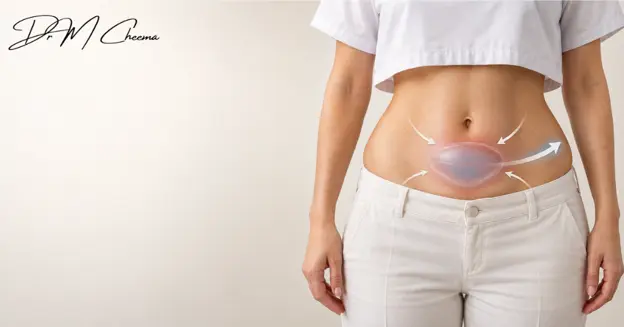
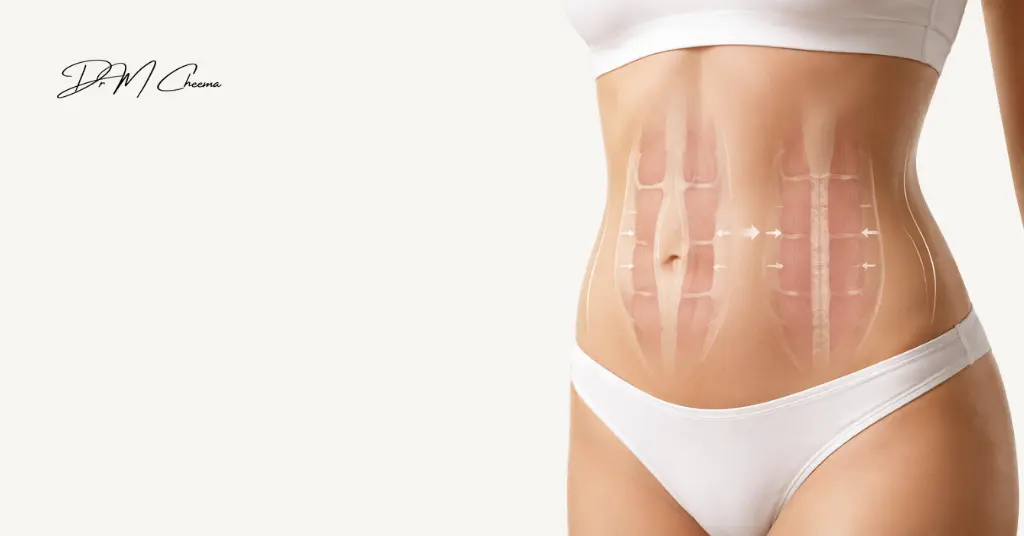
Pregnancy, significant weight loss and changes to the abdominal wall can leave the stomach looking rounded or protruding, even when you exercise regularly and maintain a healthy weight.
In some cases, the issue is not excess fat alone. It may be caused by diastasis recti, a separation of the abdominal muscles that occurs when the connective tissue between them becomes stretched.
Diastasis recti is common during and after pregnancy. As the uterus grows, the abdominal wall stretches and the two sides of the rectus abdominis muscles move apart. For many women, this separation gradually improves after childbirth. However, in some cases, it remains and causes a persistent central bulge, abdominal weakness or a stomach that still appears pregnant despite weight loss.
So, can a tummy tuck repair diastasis recti?
In suitable patients, yes.
A tummy tuck, also known as abdominoplasty, can tighten the stretched abdominal wall using internal sutures. It can also remove excess skin and improve the overall shape of the abdomen.
At Dr Cheema‘s practices in Birmingham, Manchester and London, tummy tuck surgery is carefully planned around each patient’s anatomy, skin quality, abdominal muscle separation and personal goals.
What Is Diastasis Recti?
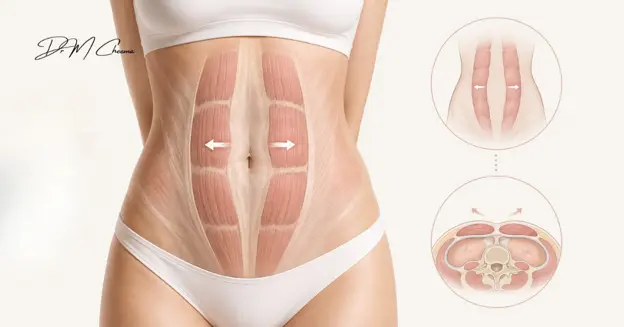
Diastasis recti, also known as rectus diastasis or abdominal muscle separation, occurs when the connective tissue between the two sides of the rectus abdominis muscles becomes stretched and widened.
The rectus abdominis muscles run vertically down the front of the abdomen and are commonly known as the “six-pack” muscles. Between them is a strong band of connective tissue called the linea alba.
When the abdominal wall is placed under prolonged pressure, the linea alba can become thinner and wider. This allows the two rectus muscles to move farther apart.
Diastasis recti is not the same as a hernia. A hernia involves an actual opening or defect in the abdominal wall through which tissue can protrude. However, both conditions can occur together, so a proper assessment is important before surgery is planned.
What Causes Diastasis Recti?
Pregnancy is one of the most common causes of diastasis recti. As the uterus expands, the abdominal wall stretches to accommodate the growing baby. Hormonal changes also affect the connective tissues, allowing the abdominal muscles to move apart.
After delivery, the abdominal wall usually begins to recover. For many women, the separation becomes smaller during the weeks and months after childbirth. For others, a wider gap remains.
Diastasis recti can also develop outside pregnancy. Significant weight gain, major weight fluctuations, obesity, ageing, genetic differences in tissue strength and repeated increases in abdominal pressure may all contribute.
Men can develop diastasis recti as well, particularly after substantial abdominal weight gain or long-term strain on the abdominal wall.
What Does Diastasis Recti Look and Feel Like?
The most recognisable sign is a ridge or bulge running vertically down the centre of the abdomen. This may become more noticeable when you sit up from lying down, cough, lift something or tighten your abdominal muscles.
Some people describe the appearance as “doming” or “coning” along the middle of the stomach.
You may also notice a persistent abdominal protrusion, reduced core strength, difficulty creating abdominal tension or changes around the belly button. Loose skin after pregnancy or weight loss can make the appearance more noticeable.
However, the appearance of your abdomen cannot confirm the diagnosis or show how severe the separation is. A professional assessment can help determine whether the problem is diastasis recti, loose skin, excess fat, a hernia or a combination of these concerns.
Does Diastasis Recti Go Away on Its Own?
Sometimes.
Abdominal separation is very common during pregnancy and does not automatically mean that surgery will be needed. The NHS notes that it often reduces during the early postnatal period.
When separation persists, physiotherapy and appropriate core rehabilitation are usually considered before surgery. These treatments can improve abdominal control, posture, breathing and the way the abdominal wall manages pressure.
However, exercise cannot always restore significantly stretched connective tissue to its original position. It also cannot remove excess skin. When persistent diastasis recti is combined with loose abdominal skin, a tummy tuck may offer a more comprehensive solution.
Can Exercise Repair Diastasis Recti?
Exercise can be highly beneficial, particularly when guided by a physiotherapist experienced in abdominal wall or postnatal rehabilitation.
Treatment may focus on deep abdominal control, breathing technique, core coordination, posture and pelvic floor function. The aim is to improve how the abdominal wall works rather than simply performing repeated sit-ups or crunches.
For many patients, physiotherapy provides meaningful improvement and surgery may not be necessary. However, if the linea alba remains significantly stretched, exercise may strengthen the surrounding muscles without fully closing the separation.
This is why treatment should be based on your symptoms, anatomy and goals rather than the appearance of your stomach alone.
Can a Tummy Tuck Repair Diastasis Recti?
Yes. A tummy tuck can include surgical repair of diastasis recti when the separation is persistent and correction is appropriate.
During a full abdominoplasty, the surgeon lifts the abdominal skin to access the underlying abdominal wall. The stretched tissue between the rectus muscles can then be tightened with strong internal sutures. This technique is commonly called rectus plication or abdominal wall plication.
The procedure can address several concerns at the same time, including:
- Diastasis recti
- Loose abdominal skin
- Central abdominal bulging
- Changes around the belly button
- Selected areas of excess fat when appropriate
The aim is to create a firmer abdominal wall and a smoother, more balanced abdominal contour.
Does a Tummy Tuck Stitch the Muscles Together?
Patients often hear that a tummy tuck “stitches the muscles back together.” This is a useful way to describe the procedure, but it is slightly simplified.
In most cases, the surgeon does not cut into and sew the muscle fibres themselves. Instead, sutures are placed through the strong tissue covering the muscles and along the stretched central line of the abdomen.
This tightens the abdominal wall and brings the two sides closer together. The technique is known as plication and can be thought of as tightening an internal support layer or corset.
What Happens During a Tummy Tuck with Diastasis Recti Repair?
A full tummy tuck with abdominal wall repair is performed under general anaesthesia. The procedure usually takes approximately two to three hours, although the duration varies depending on the amount of skin excess, the extent of muscle separation and whether other procedures are performed.
The surgeon normally makes a low abdominal incision, with the position and length determined by your anatomy and the amount of skin that needs to be removed. Where possible, the scar is placed so it can be concealed beneath underwear or swimwear.
The abdominal skin and fatty tissue are then lifted to expose the abdominal wall. If diastasis recti is present, the stretched central tissue is tightened with internal sutures.
The excess skin is pulled down and removed, and the belly button is usually brought through a new opening in the repositioned skin. The incision is then closed and dressings or a supportive garment may be applied according to your surgeon’s instructions.
Will Repairing Diastasis Recti Make My Stomach Flat?
A tummy tuck with diastasis recti repair can significantly improve abdominal contour, but no responsible surgeon can guarantee a perfectly flat stomach.
The final result depends on your degree of muscle separation, skin quality, abdominal fat, internal visceral fat, body shape, posture, previous surgery and individual healing.
Diastasis repair tightens the abdominal wall, while a tummy tuck removes excess skin. Neither procedure removes visceral fat, which is stored around the internal organs and can contribute to abdominal fullness.
This is why patients are generally advised to be at or close to a healthy, stable weight before surgery.
Does Every Tummy Tuck Include Diastasis Recti Repair?
No. Not every patient undergoing abdominoplasty has significant abdominal separation. Some patients mainly need excess skin removed, while others require more extensive abdominal wall tightening.
The decision should be based on examination rather than automatically applying the same technique to every patient. At Dr Cheema’s practices in Birmingham, Manchester and London, the procedure is tailored to each patient’s anatomy and goals.
Diastasis recti, also known as rectus diastasis or abdominal muscle separation, occurs when the connective tissue between the two sides of the rectus abdominis muscles becomes stretched and widened.
The rectus abdominis muscles run vertically down the front of the abdomen and are commonly known as the “six-pack” muscles. Between them is a strong band of connective tissue called the linea alba.
When the abdominal wall is placed under prolonged pressure, the linea alba can become thinner and wider. This allows the two rectus muscles to move farther apart.
Diastasis recti is not the same as a hernia. A hernia involves an actual opening or defect in the abdominal wall through which tissue can protrude. However, both conditions can occur together, so a proper assessment is important before surgery is planned.
What Causes Diastasis Recti?
Pregnancy is one of the most common causes of diastasis recti. As the uterus expands, the abdominal wall stretches to accommodate the growing baby. Hormonal changes also affect the connective tissues, allowing the abdominal muscles to move apart.
After delivery, the abdominal wall usually begins to recover. For many women, the separation becomes smaller during the weeks and months after childbirth. For others, a wider gap remains.
Diastasis recti can also develop outside pregnancy. Significant weight gain, major weight fluctuations, obesity, ageing, genetic differences in tissue strength and repeated increases in abdominal pressure may all contribute.
Men can develop diastasis recti as well, particularly after substantial abdominal weight gain or long-term strain on the abdominal wall.
What Does Diastasis Recti Look and Feel Like?
The most recognisable sign is a ridge or bulge running vertically down the centre of the abdomen. This may become more noticeable when you sit up from lying down, cough, lift something or tighten your abdominal muscles.
Some people describe the appearance as “doming” or “coning” along the middle of the stomach.
You may also notice a persistent abdominal protrusion, reduced core strength, difficulty creating abdominal tension or changes around the belly button. Loose skin after pregnancy or weight loss can make the appearance more noticeable.
However, the appearance of your abdomen cannot confirm the diagnosis or show how severe the separation is. A professional assessment can help determine whether the problem is diastasis recti, loose skin, excess fat, a hernia or a combination of these concerns.
Does Diastasis Recti Go Away on Its Own?
Sometimes.
Abdominal separation is very common during pregnancy and does not automatically mean that surgery will be needed. The NHS notes that it often reduces during the early postnatal period.
When separation persists, physiotherapy and appropriate core rehabilitation are usually considered before surgery. These treatments can improve abdominal control, posture, breathing and the way the abdominal wall manages pressure.
However, exercise cannot always restore significantly stretched connective tissue to its original position. It also cannot remove excess skin. When persistent diastasis recti is combined with loose abdominal skin, a tummy tuck may offer a more comprehensive solution.
Can Exercise Repair Diastasis Recti?
Exercise can be highly beneficial, particularly when guided by a physiotherapist experienced in abdominal wall or postnatal rehabilitation.
Treatment may focus on deep abdominal control, breathing technique, core coordination, posture and pelvic floor function. The aim is to improve how the abdominal wall works rather than simply performing repeated sit-ups or crunches.
For many patients, physiotherapy provides meaningful improvement and surgery may not be necessary. However, if the linea alba remains significantly stretched, exercise may strengthen the surrounding muscles without fully closing the separation.
This is why treatment should be based on your symptoms, anatomy and goals rather than the appearance of your stomach alone.
Can a Tummy Tuck Repair Diastasis Recti?
Yes. A tummy tuck can include surgical repair of diastasis recti when the separation is persistent and correction is appropriate.
During a full abdominoplasty, the surgeon lifts the abdominal skin to access the underlying abdominal wall. The stretched tissue between the rectus muscles can then be tightened with strong internal sutures. This technique is commonly called rectus plication or abdominal wall plication.
The procedure can address several concerns at the same time, including:
- Diastasis recti
- Loose abdominal skin
- Central abdominal bulging
- Changes around the belly button
- Selected areas of excess fat when appropriate
The aim is to create a firmer abdominal wall and a smoother, more balanced abdominal contour.
Does a Tummy Tuck Stitch the Muscles Together?
Patients often hear that a tummy tuck “stitches the muscles back together.” This is a useful way to describe the procedure, but it is slightly simplified.
In most cases, the surgeon does not cut into and sew the muscle fibres themselves. Instead, sutures are placed through the strong tissue covering the muscles and along the stretched central line of the abdomen.
This tightens the abdominal wall and brings the two sides closer together. The technique is known as plication and can be thought of as tightening an internal support layer or corset.
What Happens During a Tummy Tuck with Diastasis Recti Repair?
A full tummy tuck with abdominal wall repair is performed under general anaesthesia. The procedure usually takes approximately two to three hours, although the duration varies depending on the amount of skin excess, the extent of muscle separation and whether other procedures are performed.
The surgeon normally makes a low abdominal incision, with the position and length determined by your anatomy and the amount of skin that needs to be removed. Where possible, the scar is placed so it can be concealed beneath underwear or swimwear.
The abdominal skin and fatty tissue are then lifted to expose the abdominal wall. If diastasis recti is present, the stretched central tissue is tightened with internal sutures.
The excess skin is pulled down and removed, and the belly button is usually brought through a new opening in the repositioned skin. The incision is then closed and dressings or a supportive garment may be applied according to your surgeon’s instructions.
Will Repairing Diastasis Recti Make My Stomach Flat?
A tummy tuck with diastasis recti repair can significantly improve abdominal contour, but no responsible surgeon can guarantee a perfectly flat stomach.
The final result depends on your degree of muscle separation, skin quality, abdominal fat, internal visceral fat, body shape, posture, previous surgery and individual healing.
Diastasis repair tightens the abdominal wall, while a tummy tuck removes excess skin. Neither procedure removes visceral fat, which is stored around the internal organs and can contribute to abdominal fullness.
This is why patients are generally advised to be at or close to a healthy, stable weight before surgery.
Does Every Tummy Tuck Include Diastasis Recti Repair?
No.
Not every patient undergoing abdominoplasty has significant abdominal separation. Some patients mainly need excess skin removed, while others require more extensive abdominal wall tightening.
The decision should be based on examination rather than automatically applying the same technique to every patient. At Dr Cheema’s practices in Birmingham, Manchester and London, the procedure is tailored to each patient’s anatomy and goals.
Can a Mini Tummy Tuck Repair Diastasis Recti?

Sometimes, but only in carefully selected patients.
A mini tummy tuck focuses mainly on the lower abdomen below the belly button. It may be suitable for someone with limited lower-abdominal skin excess and separation confined to that area.
However, pregnancy-related diastasis recti often extends above the belly button. A mini tummy tuck may not provide enough access to correct the full separation.
If the abdominal wall is separated both above and below the belly button, a full tummy tuck may be more appropriate. The correct procedure should be selected according to your anatomy rather than simply choosing the operation with the smallest scar.
Can a Fleur-de-Lis Tummy Tuck Repair Diastasis Recti?
Yes, when appropriate.
A Fleur-de-Lis tummy tuck is designed for patients with significant excess skin in both horizontal and vertical directions, often after major weight loss. Because the procedure provides extensive access to the abdominal wall, diastasis recti can also be repaired when necessary.
However, this operation creates an additional vertical scar and is generally reserved for patients whose skin excess justifies the more extensive approach.
How Long Should You Wait After Pregnancy?
Abdominal surgery should not usually be rushed after childbirth. Your tissues need time to recover, and your weight and abdominal wall may continue to change during the postnatal period.
The NHS notes that early post-pregnancy abdominal separation can improve naturally. Some clinical guidance also recommends waiting at least one year after childbirth and completing a course of core physiotherapy before surgical repair is considered.
The right timing depends on how long it has been since pregnancy, whether you are breastfeeding, whether your weight is stable, your general health and whether you plan to have more children.
Should I Finish Having Children Before Surgery?
In most cases, it is sensible to consider tummy tuck surgery after completing your planned pregnancies.
Pregnancy after abdominoplasty is possible, but it can stretch the repaired abdominal wall, recreate separation, produce new loose skin and alter the cosmetic result.
If you are planning another pregnancy soon, postponing surgery may provide a more predictable long-term outcome.
Can Diastasis Recti Return After a Tummy Tuck?
A well-planned repair can provide long-lasting improvement, but no surgical result is completely protected from future changes.
Pregnancy, significant weight gain, major weight fluctuations and ageing can all affect the abdominal wall. Maintaining a stable weight and following your surgeon’s advice can help preserve the result.
Will Diastasis Recti Repair Improve Core Strength?
Some patients feel greater abdominal support after repair, particularly when a significant separation was present.
However, the degree of functional improvement varies. Surgery should not be promoted as a guaranteed cure for back pain, posture problems or pelvic floor symptoms because these concerns can have several different causes.
A complete assessment is important before deciding whether surgery is appropriate.
Will a Tummy Tuck Repair an Abdominal Hernia?
Not automatically.
An umbilical or abdominal hernia is different from diastasis recti and requires separate assessment. Some small hernias may be repaired during abdominal wall surgery, while larger or more complex hernias may require input from a general surgeon.
Tell your surgeon if you have a painful abdominal lump, a bulge that changes when coughing, a known hernia or previous hernia surgery.
Who May Be Suitable for Tummy Tuck and Diastasis Recti Repair?
You may be suitable if you have persistent abdominal separation alongside loose skin or concerns about abdominal contour.
Good candidates are generally in good overall health, close to a stable weight, non-smokers or able to stop nicotine as advised, and realistic about scars, recovery and the limitations of surgery.
Ideally, planned pregnancies should be complete before surgery.
A tummy tuck is major surgery. It is not a replacement for weight loss, physiotherapy or a healthy lifestyle.
When Might Surgery Not Be the Right Option?
Surgery may not be appropriate immediately if you have recently given birth, your separation may still improve naturally, you have not tried suitable physiotherapy or your weight is still changing significantly.
It may also be better to postpone surgery if you plan another pregnancy, smoke and cannot stop, have medical conditions that increase surgical risk or expect a perfect, scar-free result.
In some cases, the safest recommendation after consultation is to continue with rehabilitation and review the situation later.
What Happens During the Consultation?
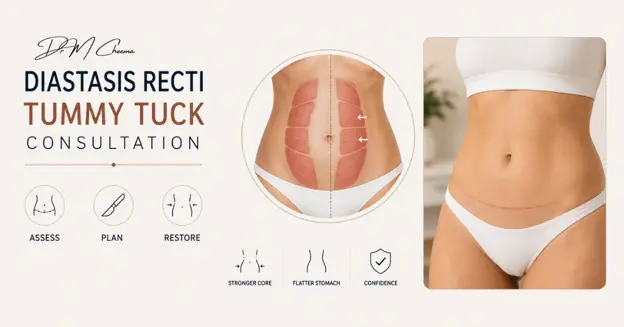
A detailed consultation helps identify what is causing the abdominal bulge and whether surgery is appropriate.
Mr Cheema will assess the degree and location of the separation, abdominal wall strength, skin excess, stretch marks, fat distribution, belly-button position, existing scars and any signs of a hernia.
You can also discuss whether a full or mini tummy tuck is more suitable, whether muscle repair is required, expected scar placement, recovery, risks and likely results.
The aim is to create a treatment plan based on your anatomy rather than using a standard approach for every patient.
Recovery After Diastasis Recti Repair and Tummy Tuck
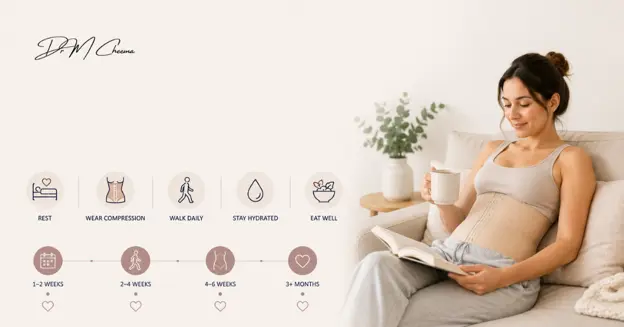
Recovery requires patience because the procedure involves both the skin and deeper abdominal tissues.
Your abdomen may feel tight, swollen and tender during the early stages. Temporary numbness, bruising and difficulty standing completely upright can also occur.
Light walking is usually encouraged to support circulation, but strenuous activity and heavy lifting must be avoided. A compression garment may be recommended, and you should follow your surgeon’s instructions regarding wound care, driving, work and exercise.
When Can I Exercise After Surgery?
Returning to exercise too quickly can place unnecessary strain on the abdominal repair.
Light walking is usually encouraged early in recovery, but activities such as running, weight training, planks, sit-ups, Pilates and heavy lifting should be reintroduced gradually and only when your surgeon confirms that healing has progressed sufficiently.
The abdominal wall may feel stronger before the deeper tissues have fully healed, so comfort alone should not determine when you return to exercise.
What Scar Does a Tummy Tuck Leave?
A tummy tuck leaves a permanent scar.
With a standard full abdominoplasty, the main scar usually runs across the lower abdomen from one side towards the other. There is also generally a scar around the belly button.
The scar may initially appear red, raised, firm or darker than the surrounding skin. It usually changes and softens over time, but it will not disappear completely.
The final appearance depends on your skin type, healing response, the amount of skin removed and whether you have had previous surgery or inflammation.
What Are the Risks of Tummy Tuck Surgery?
Tummy tuck surgery is a major procedure and carries potential risks. These include bleeding, infection, seroma, delayed wound healing, noticeable scarring, changes in sensation, asymmetry, blood clots, anaesthetic complications and the possibility of revision surgery.
Abdominal wall tightening can also create a feeling of tightness during recovery.
The potential benefits, limitations and risks should be discussed carefully during your consultation.
Will Weight Loss Fix Diastasis Recti?
Weight loss can reduce abdominal fat and make the stomach smaller overall, but it does not necessarily repair the stretched linea alba or bring separated muscles back together.
Significant weight loss may also make loose skin more noticeable.
For patients who are overweight, reaching a healthier and more stable weight before surgery may reduce risk and improve the predictability of the result.
Is Liposuction Enough for Diastasis Recti?
No.
Liposuction removes selected areas of fat but does not repair separated abdominal muscles, tighten the linea alba or remove significant loose skin.
It may be suitable for patients with good skin quality and localised fat but no muscle separation. In some cases, liposuction can be combined with a tummy tuck to improve contour, but it cannot replace abdominal wall repair.
Diastasis Recti Repair vs Tummy Tuck: Are They the Same?
No.
Diastasis recti repair refers specifically to tightening the stretched abdominal wall. A tummy tuck addresses abdominal contour more broadly by removing excess skin and reshaping the abdomen.
A tummy tuck may include diastasis repair, but not every patient with diastasis recti needs a traditional abdominoplasty. The most suitable approach depends on the amount of skin excess, the location of the separation and your individual goals.
What Results Can You Expect?
When appropriately planned, tummy tuck surgery with diastasis recti repair may provide a flatter abdominal profile, firmer abdominal support, reduced central bulging, improved waist definition and removal of excess skin.
The result becomes clearer as swelling reduces. However, a tummy tuck creates improvement rather than perfection. Permanent scars remain, and some abdominal fullness may persist depending on your anatomy and internal fat distribution.
How Long Do the Results Last?
The results can be long-lasting. Removed skin does not grow back, and the abdominal repair can remain stable when your weight is maintained.
Pregnancy, significant weight changes, ageing and changes in skin elasticity can alter the result over time.
Maintaining a healthy, stable weight gives you the best opportunity to preserve the improvement.
Why Choose an Experienced Plastic Surgeon?
Diastasis recti repair requires more than creating a flatter stomach. Your surgeon must assess the abdominal wall, skin distribution, fat distribution, existing scars, belly-button position, body proportions and any possible hernias.
At Dr Cheema’s practices in Birmingham, Manchester and London, tummy tuck surgery is individually planned, with abdominal wall repair included when diastasis recti is present and correction is appropriate.
Tummy Tuck for Diastasis Recti in Birmingham
If pregnancy or significant weight changes have left you with a persistent abdominal bulge, loose skin or suspected muscle separation, losing more weight may not address the underlying problem.
For some patients, physiotherapy and core rehabilitation are enough. For others, a tummy tuck with diastasis recti repair can address both the abdominal wall and excess skin in one procedure.
The first step is a detailed consultation to understand what is causing your abdominal changes and whether surgery is suitable.
A Personalised Approach to Abdominal Contouring
Diastasis recti can be frustrating, especially when you have returned to a healthy weight and strengthened your core but still notice a central bulge.
A tummy tuck may repair significant abdominal separation while removing stretched skin that exercise cannot correct. However, surgery is not automatically the right option for everyone.
Your treatment plan should consider the severity of the separation, your response to physiotherapy, skin excess, weight stability, general health, previous pregnancies, future pregnancy plans and personal goals.
Arrange Your Tummy Tuck Consultation
If you are concerned about diastasis recti after pregnancy or weight loss? Arrange a consultation with Mr Mubashir Cheema in Birmingham, Manchester or London to discuss your options.
Frequently Asked Questions
Can a tummy tuck repair diastasis recti?
Yes. A tummy tuck can tighten the stretched abdominal wall and bring the separated rectus muscles closer together. The extent of correction depends on the severity and location of the separation and your individual anatomy.
Can exercise close diastasis recti?
Physiotherapy and specialist core rehabilitation can improve abdominal function and may reduce the separation. However, significantly stretched connective tissue may not fully recover through exercise alone.
Do I need a tummy tuck if I have diastasis recti?
It can. Future pregnancy, significant weight changes and renewed stretching of the abdominal wall may affect the repair and alter the result.
Can diastasis recti return after a tummy tuck?
Some scarring is expected, but Mr. Cheema uses techniques to ensure incisions are placed in discreet, natural folds. Scars typically fade over time and can be further minimised with proper care and scar management. Most patients find the relief and confidence gained from the procedure far outweigh any visible scarring.
Is diastasis recti the same as an umbilical hernia?
No. Diastasis recti is widening of the connective tissue between the abdominal muscles, while a hernia involves an actual defect in the abdominal wall. Both conditions can occur together and should be assessed separately.