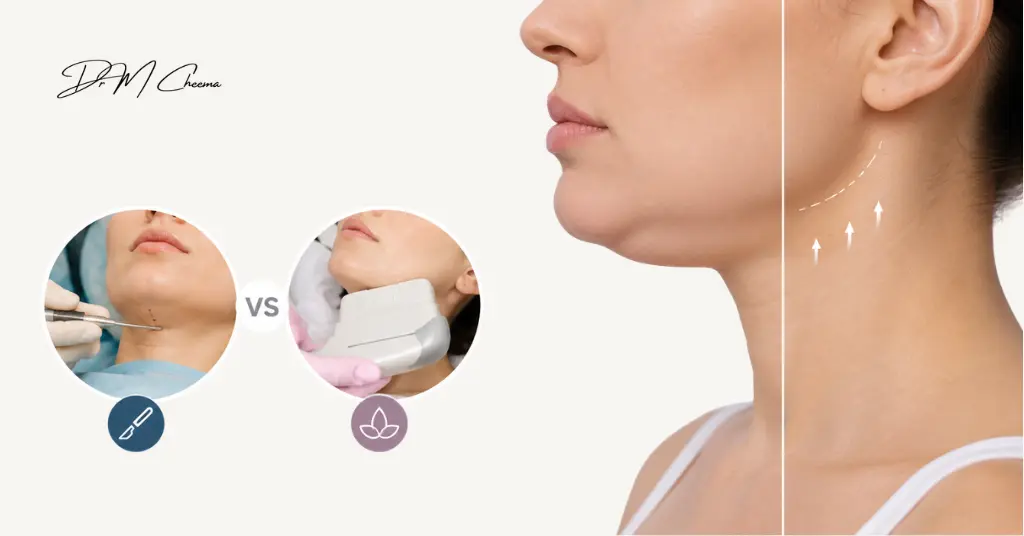
A double chin can affect the appearance of your entire facial profile. Even if you are otherwise slim and maintain a healthy weight, fullness beneath the chin can soften the jawline, reduce the definition between the face and neck and make the lower face appear heavier than you would like.
For this reason, double chin removal is an increasingly common concern among men and women who want a more defined chin and jawline.
Some people may benefit from chin liposuction, which physically removes unwanted fat from beneath the chin. Others may prefer a non-surgical treatment because they want minimal downtime or are not ready to undergo an operation.
However, choosing between surgical and non-surgical treatment is not simply a matter of deciding which option sounds easier. A double chin can be caused by excess fat, loose skin, genetics, reduced chin projection or a combination of these factors. The most suitable treatment depends on what is actually creating the fullness beneath your chin.
At Mr Cheema’s Birmingham practice, facial contouring treatments are tailored to each patient’s anatomy, concerns and aesthetic goals. Available treatment approaches may include liposuction and minimally invasive facial contouring using techniques such as dermal fillers and thread lifts.
Understanding the differences between these options can help you make a more informed decision about double chin removal.
What Is a Double Chin?
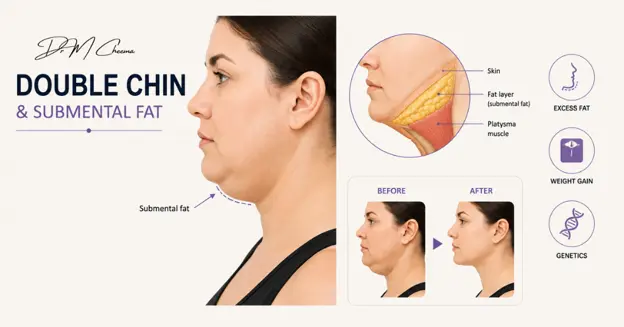
A double chin is the common term for fullness beneath the chin, medically known as submental fullness.
The area beneath the jaw naturally contains a layer of fat. When this becomes more prominent, the angle between the chin and neck can become less defined. Instead of a clear transition from the jawline into the neck, the lower face may appear rounder or heavier.
Although weight gain can contribute to a double chin, being overweight is not necessary to develop one. Many people seeking treatment are already at a healthy weight but continue to have a pocket of fat beneath the chin that does not respond significantly to diet or exercise.
Why Do People Develop a Double Chin?
Genetics can play a significant role. Some people naturally store more fat beneath the chin, meaning the area can remain prominent even when the rest of the body is relatively lean.
Ageing is another important factor. As the skin loses elasticity, the tissues around the jawline and neck can begin to loosen. What appears to be excess fat may therefore be a combination of fat and skin laxity.
Weight gain can increase the size of fat cells beneath the chin, while significant weight loss may leave loose skin after the fat has reduced. Facial structure also influences the appearance of the lower face. A smaller or less projecting chin can make submental fullness appear more noticeable because there is less skeletal definition between the chin and neck.
This is why successful double chin removal begins with identifying whether the main concern is fat, loose skin, facial structure or a combination of factors.
Can Weight Loss Get Rid of a Double Chin?
Sometimes, but not always.
If your double chin is mainly related to overall weight gain, losing weight through a healthy diet and regular exercise may reduce some of the fullness beneath your chin. However, it is not possible to choose where the body loses fat first.
Some people reach a healthy weight and find that their double chin remains largely unchanged because their genetics naturally favour fat storage in this area.
Chin liposuction is designed for localised fat deposits that persist despite weight management. It is a body-contouring procedure, not a weight-loss treatment. The best candidates are generally close to their healthy, stable weight and have a specific area of fat they would like to address.
Do Double Chin Exercises Work?
There are many exercises online that claim to remove a double chin by repeatedly moving the jaw, tongue or neck.
These exercises may strengthen some of the muscles around the neck, but they cannot selectively remove a pocket of subcutaneous fat. Fat loss occurs through overall energy balance rather than by exercising a specific area directly beneath the skin.
If your double chin is related to general weight gain, overall weight management may help. If it is caused by genetically distributed submental fat, however, chin exercises are unlikely to create the degree of contouring many people want.
What Is Chin Liposuction?

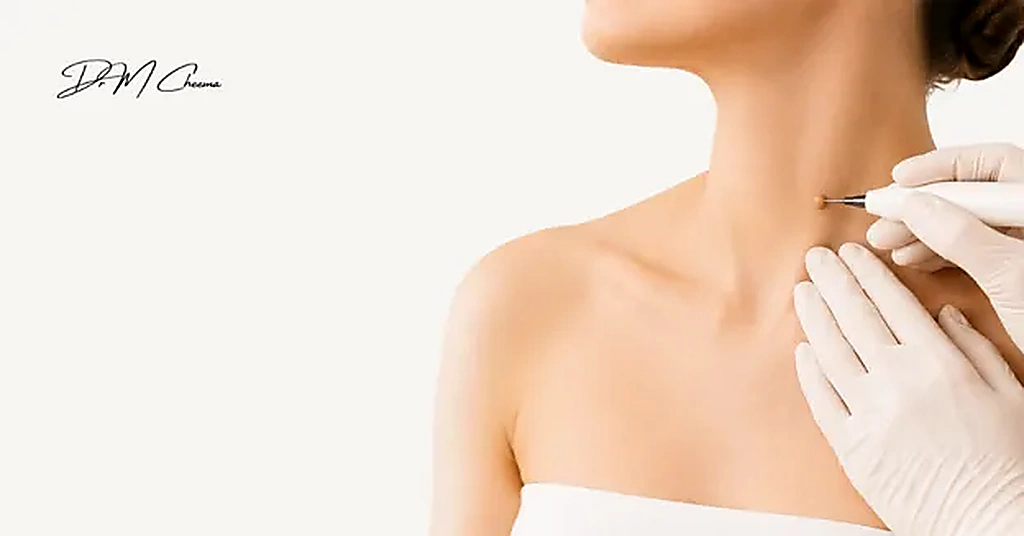
Chin liposuction, also known as submental liposuction, is a surgical procedure that removes unwanted fat from beneath the chin and around the upper neck.
The procedure uses the same basic principle as liposuction elsewhere on the body, but the treatment area requires particular precision because it is relatively small and has a major influence on facial balance.
During chin liposuction, small incisions are made in discreet locations. A thin tube called a cannula is then inserted beneath the skin to remove selected fat deposits.
The aim is not to remove as much fat as possible. Effective chin liposuction involves carefully sculpting the area so that the transition between the chin, jawline and neck appears smoother and more naturally defined.
How Does Chin Liposuction Improve a Double Chin?
Submental fat can conceal the natural structure of the jawline. When carefully selected fat is removed, the underlying contours may become more visible.
This can create a clearer angle between the chin and neck and make the lower face appear more defined. For the right patient, even a relatively small change beneath the chin can have a noticeable effect on the overall profile.
The aim is not to change your facial identity or create an unnatural appearance. Instead, chin liposuction is intended to reveal more of the structure that is already present beneath the unwanted fat.
Who Is Suitable for Chin Liposuction?
The best candidates typically have a defined pocket of unwanted fat beneath the chin and reasonably good skin elasticity.
Skin quality is important because, after fat is removed, the overlying skin needs to adapt to the new contour. A younger patient with good elasticity and isolated submental fat may therefore achieve a different result from an older patient whose apparent double chin is mainly caused by loose skin.
Age alone does not determine suitability. The important consideration is the relationship between the amount of fat, the quality of the skin and the underlying facial anatomy.
A consultation is necessary to assess these factors before deciding whether chin liposuction is appropriate.
What Happens During Chin Liposuction?
The exact technique depends on the amount of fat being removed and whether other procedures are being performed at the same time.
The chin and neck are first assessed and marked carefully. Small incisions are then made, often in discreet locations beneath the chin or near the jawline. A fine cannula is passed through the fatty layer so that the surgeon can remove fat in a controlled and even manner.
Because facial contours are highly visible, careful attention must be paid to symmetry and to the transition between treated and untreated areas.
For selected standalone procedures, chin liposuction may be performed under local anaesthetic. The appropriate form of anaesthesia depends on the procedure and your individual circumstances.
Is Chin Liposuction Permanent?
The fat cells physically removed during liposuction do not simply grow back. This means chin liposuction can provide a long-lasting improvement.
However, the treated area is not completely protected from future weight changes. Fat cells remain around the chin and elsewhere in the body. Significant weight gain can enlarge these remaining cells and alter the contour again.
Maintaining a relatively stable weight gives you the best opportunity to preserve your result.
Does Chin Liposuction Tighten Loose Skin?
This is one of the most important questions when considering double chin removal.
Traditional liposuction removes fat but does not remove significant amounts of loose skin. When the skin has good elasticity, it may contract and adapt to the reduced volume beneath it.
However, if you already have substantial skin laxity, removing fat alone may leave the skin looking loose or make the laxity more noticeable. In this situation, a different procedure, such as a neck lift or another skin-tightening treatment, may be more appropriate.
This is why the question is not simply, “Can the fat be removed?” It is also important to ask, “What will happen to my skin after the fat has been removed?”
What Are the Non-Surgical Options for Double Chin Removal?
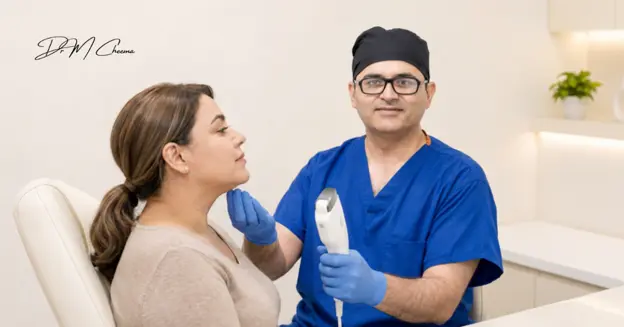
Not everyone wants liposuction. Some people have mild fullness and prefer a treatment that does not involve surgery, while others want to avoid the recovery associated with an operation.
Non-surgical approaches to submental fullness may include injectable fat-reduction treatments, cryolipolysis, radiofrequency and ultrasound-based technologies. These treatments differ considerably in how they work, how many sessions may be required and the type of result they can provide.
Some treatments reduce fat, while others primarily improve skin firmness or jawline definition. These approaches should not be considered interchangeable.
Non-surgical treatment may be suitable for carefully selected patients, but the results are generally more gradual and may be more subtle than those achieved through liposuction.
Fat-Dissolving Injections for a Double Chin
Fat-dissolving injections are designed to disrupt fat cells within the layer beneath the chin. One established example is deoxycholic acid.
In the United States, prescription deoxycholic acid is approved under the brand name Kybella for moderate to severe submental fat in adults. Patients in the UK should not assume that every injectable product advertised online has the same regulatory approval, evidence or quality standards.
Before treatment, it is important to confirm the product being used, its regulatory status and the qualifications of the practitioner administering it.
Fat-dissolving injections can be appealing because they do not involve surgical incisions. However, non-surgical does not mean risk-free or completely free from recovery. Swelling can be significant, particularly during the first few days, and bruising, tenderness, numbness and temporary firmness may also occur.
Several treatment sessions may be required, depending on the amount of fat and the desired result. Injectable fat reduction is generally more suitable for relatively small amounts of submental fat and patients whose skin still has reasonable tone.
Why You Should Be Careful with Fat-Dissolving Injections
Fat-dissolving injections are widely promoted online, sometimes at unusually low prices. This should be approached with caution.
The area beneath the chin contains important nerves, blood vessels, glands and other structures. Injection depth and placement therefore matter. Incorrect treatment can lead to complications, including prolonged swelling, infection, scarring, skin damage or nerve-related problems.
You should never purchase injectable fat-dissolving products online or attempt to use them yourself. Any double chin treatment involving injections should be carried out only after an appropriate assessment by a properly qualified healthcare professional.
Cryolipolysis and Fat Freezing
Cryolipolysis, commonly known as fat freezing, uses controlled cooling to damage selected fat cells while aiming to protect the surrounding tissues.
The body gradually processes the affected cells over the following weeks and months. As a result, cryolipolysis does not provide the immediate mechanical fat removal achieved through liposuction.
Several treatments may be required, and the final result develops gradually. For someone with a small pocket of fat who strongly wishes to avoid surgery, cryolipolysis may be worth discussing if an appropriate regulated device and experienced practitioner are available.
For someone seeking a more significant reduction from a single treatment, chin liposuction may offer greater control over the amount and distribution of fat removed.
Radiofrequency and Ultrasound Treatments
Some non-surgical technologies use controlled energy to target tissues beneath the skin. Depending on the device, radiofrequency or ultrasound may be used to address small areas of fat, encourage tissue contraction or improve the appearance of mild skin laxity.
These treatments may be useful when the concern involves a combination of mild fullness and reduced skin firmness. However, they should not be presented as equivalent to surgical liposuction.
The effects are generally more gradual and subtle. Someone with a more prominent double chin may therefore be disappointed if they choose a minimally invasive treatment expecting the same result as surgical fat removal.
Can Dermal Fillers Remove a Double Chin?
No. Dermal fillers do not remove submental fat.
However, fillers may still have a role in improving the appearance of the lower face. In some people, the profile appears less defined because the chin has limited projection. Carefully placed filler can enhance chin projection and improve the relationship between the chin and neck, even though the fat itself has not been removed.
Jawline contouring may also improve definition along the lower face in selected patients. This approach is particularly relevant when facial structure contributes to the appearance of a double chin.
Can a Thread Lift Remove a Double Chin?
A thread lift does not suction out or destroy a significant pocket of fat. Its purpose is different.
Threads may provide a lifting and contouring effect in carefully selected patients with mild tissue laxity. If the main concern is loose tissue around the lower face rather than substantial submental fat, a thread lift may improve jawline definition.
However, a thread lift cannot reproduce the effect of removing a significant pocket of fat through liposuction. This highlights why double chin removal can mean different things for different people.
One patient may need fat reduction, another may need improved chin projection, while someone else may require skin tightening. Some patients may benefit from a combination of treatments.
Chin Liposuction vs Non-Surgical Double Chin Treatment
The main difference between chin liposuction and non-surgical treatment is the degree and predictability of fat reduction.
Chin liposuction physically removes selected fat during one surgical procedure. This gives the surgeon direct control over the contour and may make it more suitable when there is a clearly defined pocket of submental fat.
Non-surgical treatments work more gradually. They may appeal to people with mild fullness who strongly prefer to avoid surgery, but several sessions may be required and the result may be more subtle.
Recovery is another important consideration. Liposuction involves an operation, so swelling, bruising and a period of healing should be expected. Non-surgical treatments generally involve fewer restrictions on normal activities, although some can still cause noticeable swelling, tenderness or temporary firmness.
Neither option should be selected before assessing skin quality. If significant laxity is present, straightforward fat reduction may not provide the desired result on its own.
Which Provides Better Results?
There is no universal answer.
If you have a moderate pocket of fat, good skin elasticity and want a clear contouring change, chin liposuction may provide a more direct and predictable result.
If your concern is mild and avoiding surgery is your priority, a suitable non-surgical treatment may provide enough improvement.
The best result comes from matching the treatment to your anatomy rather than choosing a procedure based solely on popularity, price or online photographs.
How Quickly Will I See Results from Chin Liposuction?
Chin liposuction removes the targeted fat during the procedure, but the final result is not visible immediately.
Swelling develops after surgery and can temporarily conceal the new contour. As the swelling gradually reduces, the chin and jawline become more defined.
Early improvement may be noticeable relatively soon, but the tissues continue to settle over the following weeks and months. It is therefore important not to judge the final result during the first few days after treatment.
How Quickly Do Non-Surgical Treatments Work?
Non-surgical fat-reduction treatments generally take longer to produce visible results.
Because they damage or disrupt fat cells rather than physically removing them, the body needs time to process the treated tissue. Changes may begin to appear after several weeks and continue developing over time.
Depending on the treatment used, additional sessions may be required. This should be considered when comparing costs. Although one non-surgical session may appear less expensive than chin liposuction, the total cost can increase if several treatments are needed.
What Is Recovery Like After Chin Liposuction?
Swelling and bruising are normal during the early recovery period. The chin and neck may temporarily feel firm, tender or numb.
A supportive chin garment may be recommended for a period after surgery to support the tissues while swelling settles. You will receive specific instructions about wound care, sleeping position, exercise and returning to normal activities.
Many patients can resume routine activities within approximately one to two weeks, although individual recovery varies and residual swelling may take longer to disappear.
What Are the Risks of Chin Liposuction?
Chin liposuction is cosmetic surgery and carries potential risks. These may include bleeding, infection, fluid collections, prolonged swelling, contour irregularity, asymmetry, changes in sensation, scarring and an unsatisfactory cosmetic result.
Important nerves and structures are located around the jaw and neck, so careful anatomical knowledge and surgical technique are essential.
Choosing an appropriately trained plastic surgeon and following post-operative instructions carefully can help reduce risks, although no procedure is completely risk-free.
Is Non-Surgical Double Chin Removal Safer Than Liposuction?
It is tempting to assume that non-surgical treatment is automatically safer, but the reality is more nuanced.
Avoiding an incision and general anaesthesia may reduce some surgical risks, but every non-surgical treatment has its own potential complications. Fat-dissolving injections, for example, can cause considerable swelling and require detailed knowledge of the anatomy beneath the jaw.
Device-based treatments must also be selected and applied correctly.
The safest treatment is not necessarily the least invasive option. It is the treatment that is appropriate for your anatomy and performed correctly by a properly trained practitioner.
What If My Double Chin Is Mainly Loose Skin?
If loose skin is the main concern, the treatment plan may be very different.
Removing fat beneath already loose skin can sometimes make the neck appear more deflated rather than more defined. Depending on the anatomy, a chin tuck, neck lift or another procedure designed to tighten or remove excess skin may be more appropriate.
An assessment should therefore consider the quality and elasticity of your skin, not just the amount of fat beneath your chin.
What If I Have a Weak or Recessed Chin?
The appearance of a double chin can sometimes be partly related to facial proportions.
A chin with limited projection can reduce the definition between the chin and neck, making even a relatively small amount of submental fat appear more prominent.
In selected patients, improving chin projection can create a more balanced profile. This may involve carefully placed dermal filler or surgical chin augmentation, depending on the individual circumstances.
This is another reason why removing fat is not always the best solution.
Does Chin Liposuction Leave Scars?
Chin liposuction requires small incisions, usually placed in discreet locations beneath the chin or near the jawline.
Any incision can leave a scar, although these scars are generally small and become less noticeable as they mature. Their final appearance depends on your skin type, genetics, healing response, incision placement and aftercare.
No responsible surgeon should promise completely scar-free surgery.
Will a Double Chin Come Back After Treatment?
Fat removed through liposuction is permanently removed from the treated fat-cell population. Non-surgical treatments that successfully destroy fat cells can also provide long-lasting reduction in those cells.
However, neither treatment prevents future weight gain. Remaining fat cells can enlarge, and ageing may lead to further skin laxity around the neck and jawline.
Maintaining a stable weight and looking after your general skin health can help preserve the improvement.
Can Men Have Double Chin Removal?
Yes. Submental fullness affects both men and women.
For men, reducing fullness beneath the chin may help reveal a stronger transition between the chin, jaw and neck. However, facial contouring should be tailored to the individual rather than approached in exactly the same way for every patient.
The natural shape of the jaw, chin projection, neck anatomy and desired outcome all influence treatment planning.
Is Double Chin Removal Suitable After Weight Loss?
It can be, but the appropriate treatment depends on what remains after weight loss.
Some patients retain a small pocket of stubborn submental fat, while others lose most of the fat but are left with loose skin. These concerns require different approaches.
Chin liposuction may help someone with persistent fat and good skin quality. A patient with substantial loose skin may instead require a procedure capable of tightening or removing that skin.
It is also preferable for your weight to be reasonably stable before undergoing long-term facial contouring treatment.
How Much Does Double Chin Removal Cost?
There is no single price because double chin removal can refer to several different procedures.
The cost may depend on whether you require chin liposuction, injectable treatment, device-based fat reduction, jawline or chin contouring, a skin-tightening procedure or a combination of treatments.
For surgical treatment, factors such as anaesthesia, operating facilities, surgeon fees and aftercare may also influence the final quotation.
An accurate price can only be provided after your chin and neck have been assessed and the appropriate treatment identified.
Why Is a Consultation Important?

A common mistake is choosing a procedure before having a professional facial assessment.
You may believe that you need liposuction but discover that your submental fat is relatively minor and that improving chin projection would create greater balance. Alternatively, you may request non-surgical treatment even though the amount of fat present means several sessions would be needed to achieve a less predictable result.
You may also think the problem is fat when skin laxity is actually responsible for most of the appearance.
A consultation should answer three important questions:
What is creating the double chin?
Which treatment addresses that cause?
What result can realistically be achieved with your anatomy?
Once these questions have been answered, choosing between surgical and non-surgical treatment becomes much easier.
Why Choose Mr Cheema for Double Chin and Jawline Contouring?
Facial contouring is about proportion, not simply removing fat.
The chin, jawline and neck need to be assessed together because changing one area can influence how the others appear.
Mr Mubashir Cheema is an internationally trained Plastic, Reconstructive & Aesthetic Surgeon with more than 20 years of experience. His practices in Birmingham, Manchester and London offer surgical body-contouring procedures such as liposuction, alongside minimally invasive facial contouring approaches including dermal fillers and thread lifts.
This allows your consultation to focus on the outcome you want rather than assuming that every double chin requires the same treatment.
Chin Liposuction or Non-Surgical Treatment: Which Is Right for You?
If your main concern is a distinct pocket of fat beneath the chin and your skin has good elasticity, chin liposuction may offer the most direct approach to double chin removal.
If you have mild fullness and want to avoid surgery, a suitable non-surgical fat-reduction treatment may be worth considering.
If skin laxity is more significant than fat, removing fat alone may not provide the result you want. If your chin lacks projection, improving facial proportions may create a better profile than focusing solely on the area beneath the chin.
There is no universally best double chin treatment. The most appropriate option is the one that addresses the reason your double chin exists.
Define Your Jawline with a Personalised Consultation
Explore double chin removal options with Dr Cheema in Birmingham, Manchester or London, and get advice tailored to your anatomy and goals.
Take the Next Step Towards a More Defined Jawline
If fullness beneath your chin is affecting the definition of your profile, you do not need to choose between chin liposuction and non-surgical treatment based on online photographs or social media trends.
An individual assessment can determine whether your concern is primarily caused by submental fat, skin laxity, facial structure or a combination of factors.
Mr Cheema can assess your chin, jawline and neck and discuss the treatment options most appropriate for your anatomy and expectations.
Frequently Asked Questions About Double Chin Removal
What is the best treatment for double chin removal?
There is no single best treatment for everyone. Chin liposuction may be effective for patients with a localised pocket of fat and good skin elasticity. Non-surgical approaches may suit smaller amounts of fat, while significant loose skin may require a different procedure.
Does chin liposuction permanently remove a double chin?
The fat cells removed through liposuction are permanently removed. However, significant future weight gain can enlarge the fat cells that remain and alter the contour of the chin and neck.
Can I remove a double chin without surgery?
Non-surgical fat-reduction treatments include injectable and device-based approaches. They generally produce more gradual changes and may require several sessions. Suitability depends on the amount of fat, skin quality and your desired result.
How long does chin liposuction take to heal?
Swelling and bruising are expected during early recovery and gradually improve. Many patients return to normal daily activities within approximately one to two weeks, although residual swelling can take longer to settle.
Does chin liposuction tighten my neck?
Liposuction removes fat rather than significant loose skin. Patients with good skin elasticity may see the skin adapt to the new contour, but substantial skin laxity may require a separate tightening procedure.