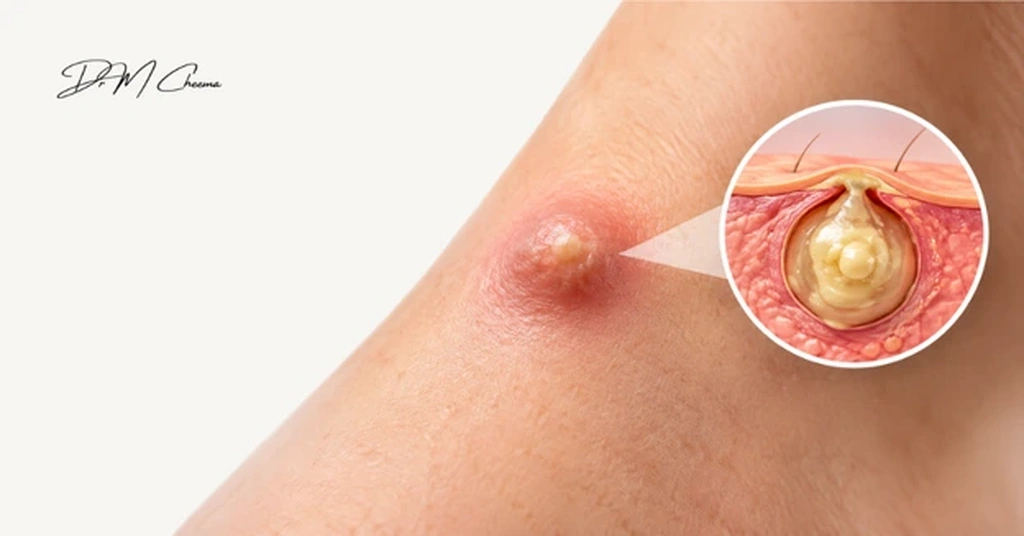
Finding a smooth lump beneath your skin can be unsettling, especially if it gradually becomes larger or develops a small opening in the centre. If thick material comes out when pressure is applied, you may be tempted to squeeze the lump until it appears empty.
However, squeezing a suspected skin cyst is not a safe or reliable way to treat it. It can rupture the cyst wall, cause inflammation, introduce infection, increase scarring and make future removal more difficult.
The lump commonly referred to as a sebaceous cyst is often an epidermoid cyst or, particularly on the scalp, a pilar cyst. These cysts are usually benign, but emptying their contents does not necessarily remove the cyst itself. If the cyst lining remains beneath the skin, it can continue producing material and gradually fill again.
This is why effective sebaceous cyst removal involves more than simply releasing the visible contents. A professional assessment can establish what the lump is and whether treatment is necessary. When removal is appropriate, the aim is usually to remove the cyst and its lining as completely as possible.
At Mr Cheema’s Birmingham and Manchester practices, with a London practice opening soon, patients can receive specialist assessment for minor surgical and skin concerns. Treatment recommendations are based on the individual lesion, its location, symptoms and the patient’s preferences.
What Is a Sebaceous Cyst?
The term sebaceous cyst is widely used, although it is not always medically accurate. Many lumps described in this way are actually epidermoid cysts.
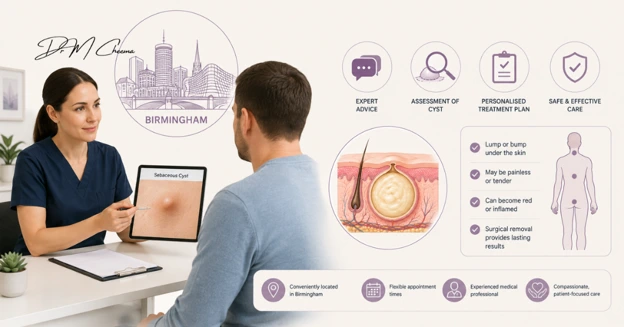
An epidermoid cyst is a sac beneath the skin lined with cells similar to those found on the skin’s surface. These cells produce keratin, a protein found in the skin, hair and nails. As keratin accumulates inside the sac, the cyst gradually enlarges and may eventually produce thick, white or yellow material.
The term sebaceous cyst is often used because the lump may appear to be associated with an oil-producing gland. However, epidermoid cysts do not usually arise from sebaceous glands, and their contents are primarily keratin rather than sebum.
Another common type is a pilar cyst, also known as a trichilemmal cyst. Pilar cysts develop from structures associated with hair follicles and are particularly common on the scalp.
Throughout this article, the familiar term “sebaceous cyst” is used for clarity. During a medical assessment, however, the lump may be diagnosed more precisely as an epidermoid cyst, pilar cyst or another type of skin lesion.
What Does a Sebaceous Cyst Look and Feel Like?
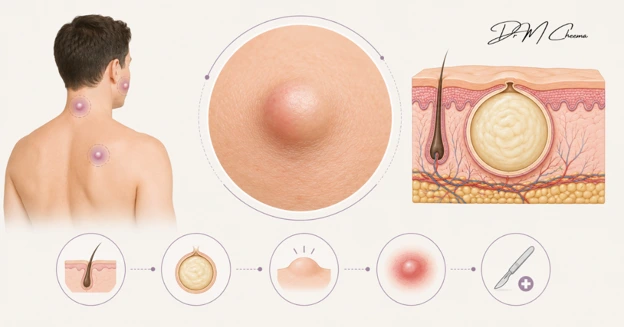
A typical epidermoid cyst appears as a rounded lump just beneath the skin. It usually grows slowly and may remain unchanged for months or years without causing discomfort.
The skin over the cyst may look completely normal. Some cysts have a small dark opening in the centre, known as a punctum. If material comes through this opening, it may be thick, creamy or cheese-like and can sometimes have an unpleasant smell.
Epidermoid cysts commonly develop on the face, neck, chest, shoulders and back, although they can occur almost anywhere on the body. Pilar cysts are especially common on the scalp.
Skin cysts can vary considerably in size, from smaller than a pea to several centimetres across. If a lump is growing, painful, inflamed or unfamiliar, it should be assessed rather than assumed to be a harmless cyst.
Are Sebaceous Cysts Dangerous?
Most epidermoid and pilar cysts are benign and do not pose a serious health risk. A small cyst that is painless, stable and not causing cosmetic or practical problems may not require treatment.
However, not every lump beneath the skin is a cyst. Lipomas, abscesses, enlarged lymph nodes and other skin or soft-tissue lesions can sometimes look similar. This is why an unexplained lump should be assessed by a qualified medical professional.
Medical advice is particularly important if the lump is rapidly enlarging, unusually firm, persistently painful, repeatedly bleeding, ulcerated or changing in appearance. A professional examination can help determine whether the lump is suitable for observation or whether further investigation or treatment is needed.
Why Do Sebaceous Cysts Develop?
Epidermoid cysts usually develop when skin cells that would normally shed from the surface become trapped beneath the skin. These cells continue producing keratin inside an enclosed sac, causing the cyst to enlarge gradually.
Sometimes there is no obvious reason why this happens. In other cases, a cyst may develop after an injury or trauma causes surface skin cells to become implanted deeper within the skin.
Pilar cysts develop from the outer root sheath of a hair follicle and may run in families. They are often found on the scalp and can occur as a single lump or as several cysts.
The development of a cyst does not mean that your skin is dirty or that you have done anything wrong. Cleaning or squeezing the area cannot remove the underlying cyst wall.
Why Is It So Tempting to Squeeze a Sebaceous Cyst?
A visible punctum can make a cyst look like a large spot or blocked pore. If squeezing causes some material to come out, the lump may temporarily become smaller. This can create the impression that the problem has been solved.
A cyst, however, is different from a simple blocked pore. Beneath the skin is a defined sac or capsule containing keratin. Squeezing may release some of the contents, but it does not necessarily remove the sac itself.
A useful way to understand this is to imagine a small balloon filled with material. Pressing the balloon may force some of its contents out, but the balloon remains. If the cyst wall is left behind, it can continue producing keratin and refill over time.
Excessive pressure can also rupture the cyst into the surrounding tissues rather than allowing its contents to escape through the surface. This can cause a sudden and painful inflammatory reaction.
Why Does Squeezing a Sebaceous Cyst Make It Worse?
Squeezing can cause several problems. The first is rupture. When the cyst wall breaks, keratin can escape into the surrounding skin. The body recognises this material as being in the wrong place and may respond with significant inflammation.
The cyst can then become red, swollen, tender and painful. This reaction may occur even when there is no bacterial infection. In some cases, the redness and swelling are caused primarily by the body’s response to escaped keratin.
This distinction is important because an inflamed cyst is not always treated in exactly the same way as an infected cyst. A medical assessment can help determine the most appropriate management.
Squeezing Can Introduce Infection
The skin acts as a protective barrier against bacteria. Repeatedly pressing, piercing or cutting a cyst damages that barrier and creates an opportunity for bacteria to enter.
Fingernails, needles and household tools are not suitable substitutes for sterile surgical equipment, even if they appear clean. Once bacteria enter the skin, a previously uncomplicated cyst can become infected.
An infected cyst may become increasingly painful, warm, swollen and red. It may also produce pus or other discharge. Treatment can then become more complicated than it would have been if the cyst had been left alone and assessed earlier.
If a cyst is already sore or red, avoid squeezing it and seek medical advice, particularly if the redness is spreading or you feel unwell.
Squeezing Does Not Remove the Cyst Wall
One of the most common misunderstandings about home cyst treatment is the belief that removing the contents means the cyst has gone.
Unfortunately, emptying the cyst is not the same as removing it. The epithelial lining of the cyst can remain beneath the skin and continue producing keratin. As a result, the lump may gradually fill again.
This explains why some people find themselves repeatedly draining the same cyst every few months. Although the lump may temporarily flatten, the underlying cause remains.
Complete surgical removal of the cyst and its lining is generally considered the most definitive treatment when removal is appropriate. Even then, recurrence cannot be ruled out completely, but removing the capsule reduces the likelihood of the cyst returning.
Rupturing a Cyst Can Make Proper Removal More Difficult
An intact cyst is often easier to identify and separate from the surrounding tissue. During surgical removal, the aim is to remove the cyst and its capsule as completely as possible.
A cyst that has previously ruptured may be more difficult to remove. Inflammation can cause the cyst wall to fragment and become attached to nearby tissues. Instead of removing one intact sac, the surgeon may need to identify and remove pieces of the cyst lining from inflamed or scarred tissue.
If any part of the lining remains, the cyst may recur. This means that repeatedly squeezing a cyst to avoid a minor surgical procedure can sometimes make eventual treatment more complicated.
Squeezing Can Increase Scarring
Aggressive squeezing damages the skin surrounding the cyst as well as the cyst itself. Repeated pressure, inflammation, rupture and infection can all increase tissue damage and the risk of scarring.
This can be particularly concerning when the cyst is on a visible area such as the face or neck. Trying to improve the appearance of a cyst by repeatedly squeezing it may ultimately make the area more noticeable.
Professional sebaceous cyst removal requires an incision and therefore leaves a scar. However, careful planning, appropriate incision placement and good surgical technique can help achieve the best possible cosmetic result.
A cyst that has already been repeatedly squeezed or infected may have caused internal scarring before surgery takes place.
Is an Inflamed Cyst the Same as an Infected Cyst?
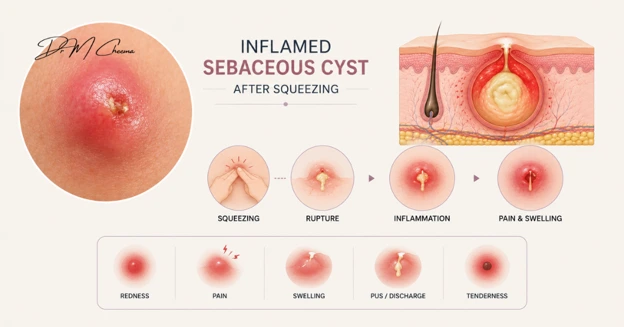
Not necessarily. An epidermoid cyst can become red, swollen and painful when its wall ruptures and keratin leaks into the surrounding tissues. This is an inflammatory reaction and does not always mean that bacteria are present.
An infected cyst may cause similar symptoms, but it may also be associated with pus, increasing warmth, spreading redness or a general feeling of illness. Because inflammation and infection can look alike, a painful or changing cyst should be assessed by a clinician.
Do not attempt to diagnose or treat a severely inflamed cyst by squeezing it. The appropriate treatment depends on whether the cyst is inflamed, infected, ruptured or simply irritated.
When Is Sebaceous Cyst Removal Recommended?
Not every cyst needs to be removed. A small, painless cyst that has remained stable and is not causing practical or cosmetic concerns can often be monitored.
Sebaceous cyst removal may be considered if the cyst is growing, repeatedly inflamed, painful, catching on clothing or hair, affecting daily activities or causing cosmetic concern. For example, a scalp cyst may catch on a comb, while a cyst on the neck may rub against shirt collars.
A visible facial cyst may also cause concern because of its appearance. In these situations, a consultation allows you to discuss whether removal is appropriate and what the procedure would involve.
Tired of Squeezing the Same Cyst?
Squeezing rarely solves the problem. A consultation can confirm whether the lump is a cyst, whether removal is suitable, and what to expect in terms of scarring, recovery and recurrence.
Arrange Your Consultation with Mr Cheema in Birmingham or Manchester
How Does Professional Sebaceous Cyst Removal Work?
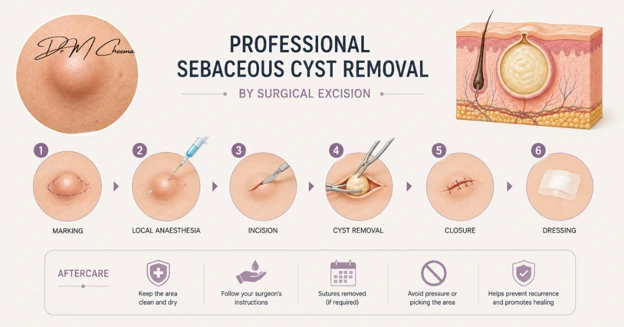
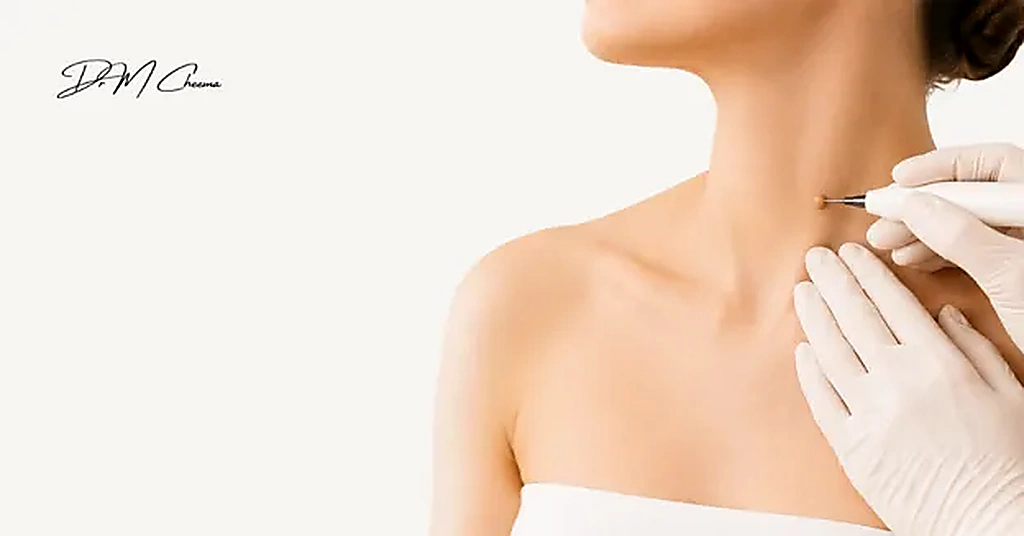
The procedure depends on the type, size and location of the cyst. A straightforward epidermoid or pilar cyst is commonly removed as a minor surgical procedure under local anaesthetic.
The local anaesthetic numbs the treatment area, allowing the procedure to be carried out while you remain awake and comfortable. A carefully planned incision is then made over or near the cyst.
The surgeon separates the cyst from the surrounding tissue and aims to remove the cyst lining as completely as possible. Once the cyst has been removed, the wound may be closed with sutures, depending on its size and location.
You will receive instructions about wound care and follow-up after the procedure. In some cases, the removed tissue may be sent for laboratory examination to confirm the diagnosis.
Why Is Removing the Entire Cyst Capsule Important?
The cyst capsule is the structure that allows the cyst to continue producing keratin. Removing only the contents may make the lump temporarily smaller, but it does not address the underlying cause.
Complete excision aims to remove the cyst and its capsule. This reduces the likelihood of recurrence compared with simply draining or squeezing the contents.
No surgical procedure can guarantee that a cyst will never return. Recurrence may occur if part of the lining remains, particularly when the cyst has previously ruptured or become inflamed. Nevertheless, removing the capsule is generally the most effective way to treat a persistent cyst.
What If the Cyst Is Already Infected?
An acutely infected or severely inflamed cyst may require a different approach from a calm, uncomplicated cyst.
Depending on the circumstances, treatment may involve antibiotics, drainage or other measures to control the infection and reduce inflammation. Definitive excision may be delayed until the acute inflammation has settled because swollen and fragile tissue can make complete removal more difficult.
If a cyst is very painful, hot, red or producing pus, seek medical advice rather than attempting to drain it yourself. Once the acute problem has been managed, the possibility of definitive removal can be discussed.
Is Draining a Cyst the Same as Removing It?
No. Drainage and excision are different treatments.
Drainage releases fluid, pus or keratin from the cyst and may relieve pressure when the area is very inflamed or infected. However, drainage does not necessarily remove the cyst lining, so the lump may return.
Excision aims to remove the cyst itself, including its wall or capsule. This is why a patient may feel better after drainage but still require further treatment if the cyst continues to recur.
Will a Sebaceous Cyst Come Back After Removal?
A completely excised cyst is less likely to return because the lining responsible for producing keratin has been removed. However, recurrence remains possible, particularly if the cyst has previously ruptured or if part of the capsule cannot be removed.
It is also possible to develop a new cyst in another area. Removing one cyst does not prevent other cysts from forming in the future.
Does Sebaceous Cyst Removal Leave a Scar?
Yes. Any procedure that cuts through the skin can leave a scar. The aim is not to promise scar-free surgery but to plan the incision carefully and use appropriate surgical technique to make the scar as discreet as reasonably possible.
The final appearance of the scar depends on the size and location of the cyst, whether it was previously inflamed or ruptured, the surgical technique used and your individual healing response.
A cyst that has been repeatedly squeezed or infected may already have caused scarring beneath the skin before removal.
Is It Better to Remove a Cyst Before It Becomes Inflamed?
When removal has been chosen, a calm cyst is often easier to remove than one that is severely inflamed or infected. An intact cyst wall can usually be identified and separated from the surrounding tissue more easily.
Once the capsule has ruptured, it may become fragmented, while inflammation and scar tissue can make the cyst more difficult to remove completely.
However, not every quiet cyst needs surgery. The decision should be based on the cyst’s symptoms, size, location, appearance and effect on your daily life.
What Happens After Sebaceous Cyst Removal?
After the procedure, the area is usually covered with a dressing. You will receive instructions about keeping the wound clean, changing the dressing and recognising signs of infection.
Some tenderness, swelling or bruising may occur during the first few days. The wound should gradually settle over the following days and weeks. If non-dissolving stitches have been used, you will be told when they need to be removed.
You may be advised to avoid activities that place tension on the wound while it heals, particularly if a larger cyst has been removed from an area that moves frequently.
The scar may initially appear red or noticeable but usually changes and fades over time. Always follow the specific aftercare instructions provided by your surgical team.
What Are the Risks of Sebaceous Cyst Removal?
Although cyst excision is generally a minor procedure, all surgery carries potential risks. These may include bleeding, infection, delayed wound healing, scar formation, changes in sensation and recurrence.
There is also a possibility that the lump is not a cyst or that its appearance differs from the initial clinical diagnosis. For this reason, the removed tissue may sometimes be sent for histological examination.
A consultation allows these risks to be discussed in relation to your individual cyst and medical history.
Can I Pop a Sebaceous Cyst with a Needle?
You should not attempt to pierce a cyst with a needle. This does not remove the cyst wall and creates an opening through which bacteria can enter.
Home piercing can cause bleeding, infection, inflammation and scarring. It may also damage nearby structures if the lump is deeper than it appears.
Most importantly, an unexplained lump cannot be confirmed as a harmless cyst simply by looking at it. Home surgery is not a safer alternative to professional assessment and treatment.
Can I Use a Warm Compress on a Cyst?
A warm compress may sometimes provide temporary comfort around an irritated superficial cyst, but it does not remove the cyst capsule and should not be considered a cure.
If you use a warm compress, avoid excessively hot water and do not apply anything that could burn or damage the skin. If the lump becomes increasingly red, hot, painful or swollen, or begins producing significant discharge, seek medical advice.
Can I Use Cyst Removal Creams?
Products marketed as “cyst removal creams” should be approached with caution. An epidermoid cyst has a capsule beneath the skin, and a surface cream cannot reliably remove that enclosed structure in the same controlled way as surgical excision.
Products that irritate or burn the skin may cause additional damage without removing the cyst wall. If you are considering treatment for a persistent cyst, obtaining a professional diagnosis is safer than applying unverified products.
What Is the Difference Between a Cyst and a Spot?
A spot or pustule is usually associated with inflammation involving a pore or hair follicle and may resolve relatively quickly. An epidermoid cyst is a defined sac beneath the skin that can remain for months or years.
Both may produce whitish material, but their underlying structures are different. A persistent lump that repeatedly refills should not be treated as though it is simply a large spot.
What Is the Difference Between a Sebaceous Cyst and a Lipoma?
A lipoma is a benign lump made up of fatty tissue. It often feels soft or rubbery and may move beneath the skin.
An epidermoid cyst is an enclosed sac containing keratin and may be more closely attached to the overlying skin. A central punctum may also be visible.
However, it is not always possible to distinguish confidently between different types of lumps without a medical examination. If you are uncertain about a lump, arrange an assessment rather than attempting to remove it yourself.
What Is a Pilar Cyst?
Pilar cysts commonly occur on the scalp. Like epidermoid cysts, they are benign sacs containing keratin, but they develop from a different part of the hair follicle and often have a thicker wall.
They may occur as a single lump or as several cysts. Pilar cysts are usually painless but can become uncomfortable if they grow, become inflamed or are traumatised while brushing, cutting or styling the hair.
An asymptomatic pilar cyst may not require treatment. Removal can be considered if it becomes painful, repeatedly irritated, difficult to manage or cosmetically concerning.
Can Sebaceous Cysts Develop on the Face?
Yes. Epidermoid cysts can develop on the face, neck and trunk.
Facial cysts require careful planning because the cosmetic result is particularly important. Repeated squeezing can increase inflammation and may worsen scarring.
When removal is planned, the incision should be positioned with consideration for natural skin lines, nearby structures and the final appearance of the scar. These factors are especially important when treating a visible area.
Can Sebaceous Cysts Develop on the Back?
The back is a common location for epidermoid cysts. Because it can be difficult to see the area yourself, a cyst may become relatively large before it is noticed.
Back cysts can also rub against clothing or become irritated by pressure. Attempting to squeeze a large cyst at home may rupture it internally and cause considerable inflammation.
If a back cyst is growing, painful or repeatedly troublesome, professional assessment is preferable.
When Should You Seek Medical Advice Quickly?
Most cysts are harmless, but changes in a lump should not be ignored. Seek medical advice if a lump becomes increasingly red, swollen or painful, particularly if the redness is spreading or you feel unwell.
You should also arrange an assessment if you have an unexplained lump, if it is rapidly enlarging, if it repeatedly bleeds or if the skin over it becomes ulcerated.
Do not repeatedly squeeze a painful lump in an attempt to make it disappear. Early assessment can help prevent avoidable inflammation, infection and scarring.
Can a Sebaceous Cyst Be Cancerous?
Typical epidermoid and pilar cysts are benign. However, not every lump that resembles a cyst is necessarily a cyst.
Malignant change within a genuine epidermoid cyst is very rare, but other skin or soft-tissue lesions can sometimes initially appear similar. This is why diagnosis should come before treatment.
A lesion that is rapidly enlarging, repeatedly bleeding, ulcerated or behaving unusually should be assessed by a medical professional rather than squeezed or treated at home.
How Much Does Sebaceous Cyst Removal Cost?
The cost of sebaceous cyst removal varies because different cysts require different procedures.
Factors that may affect the cost include the cyst’s size and location, whether it has previously ruptured, whether it is currently inflamed, the type of anaesthetic required and whether histological examination is recommended.
A small, straightforward cyst may be very different to remove from a large recurrent cyst surrounded by scar tissue. An individual consultation is therefore usually needed before an accurate treatment price can be provided.
When discussing costs, ask what is included in the quotation, such as the procedure, follow-up appointments, dressings and histology where required.
Is Sebaceous Cyst Removal Available on the NHS?
Skin cysts that are not causing problems often do not require treatment. A large or painful cyst that interferes with everyday activities may sometimes qualify for NHS treatment.
If a cyst is harmless and removal is requested mainly for cosmetic reasons, private treatment may be necessary. NHS policies can vary, so your GP can advise whether referral is appropriate in your circumstances.
Why Professional Assessment Matters Before Cyst Removal
The first step in treating any skin lump is establishing what it is. During an assessment, a medical professional may consider the lesion’s size, position, mobility, overlying skin, punctum, history and any signs of inflammation or infection.
This information helps determine whether the lump can be monitored, whether removal is appropriate, whether inflammation should settle first or whether further investigation is needed.
That decision-making cannot be replaced by watching an online cyst-popping video. Attempting to treat an unexplained lump at home may create unnecessary complications.
Stop the Cycle of Squeezing, Swelling and Refilling
emptying it again is unlikely to address the underlying cyst wall.
Professional assessment can establish whether sebaceous cyst removal is appropriate and explain the expected procedure, scar, recovery period and risk of recurrence.
Book a Personal Consultation with Mr Mubashir Cheema in Birmingham
Why Choose a Plastic Surgeon for Sebaceous Cyst Removal?
Although cyst removal is often described as minor surgery, careful surgical planning remains important. The surgeon must remove the lesion safely while considering nearby structures, wound closure and the position of the final scar.
This may be particularly relevant when the cyst is on the face or neck, relatively large, recurrent, previously infected or surrounded by scar tissue from earlier attempts at removal.
Mr Mubashir Cheema is an internationally trained Plastic, Reconstructive & Aesthetic Surgeon with practices in Birmingham, Manchester and London. Each provides specialist assessment for minor surgical and skin concerns, with treatment planned according to the individual lesion and the patient’s needs.
Sebaceous Cyst Removal in Birmingham
If you have a persistent lump that you believe may be a sebaceous cyst, the first step should not be squeezing it. The first step is to establish exactly what the lump is.
A painless cyst that is not growing or causing problems may not need removal. However, a cyst that repeatedly becomes irritated, catches on clothing, grows larger or affects your confidence may be suitable for surgical treatment.
If the cyst is already red and painful, an assessment can determine whether inflammation or infection needs to be managed before definitive removal.
At Mr Cheema’s practice, you can discuss the appearance and history of your skin lump and whether minor surgical treatment is appropriate.
Why Squeezing Is Not Sebaceous Cyst Removal
The reason squeezing so often fails comes down to one simple difference:
Squeezing removes contents. Surgery aims to remove the cyst.
When you squeeze a cyst, some keratin may escape and the lump may temporarily become flatter. However, the capsule can remain beneath the skin, allowing the cyst to refill.
If the cyst ruptures internally, it may become swollen and painful. If bacteria enter through damaged skin, infection can develop. Repeated trauma can also increase scarring and make later removal more difficult.
Professional sebaceous cyst removal addresses the structure beneath the skin rather than repeatedly treating the material that comes out of it.
Take the Next Step Towards Safe Cyst Removal
If you have repeatedly squeezed a cyst only for it to return, become painful or grow again, it may be time to consider a different approach.
A consultation gives you the opportunity to confirm whether the lump is a cyst, understand whether treatment is necessary and discuss the most appropriate method of removal.
Mr Cheema can assess your individual concern and explain what treatment may involve, including scar placement, recovery and aftercare.
Book Your Sebaceous Cyst Consultation
Get expert advice on the most suitable treatment for your cyst, with appointments in Birmingham, Manchester and London.
Frequently Asked Questions about Sebaceous Cyst Removal
Should I squeeze a sebaceous cyst?
No. Squeezing can rupture the cyst, cause inflammation, introduce infection and increase scarring. It may release some contents, but it usually leaves the cyst wall beneath the skin, allowing the lump to refill.
What is the most effective way to remove a sebaceous cyst?
When removal is appropriate, complete surgical excision of the cyst and its capsule is generally the most definitive treatment. Removing the capsule helps reduce the risk of recurrence compared with simply draining or squeezing the contents.
Can an inflamed or infected sebaceous cyst be removed?
Treatment depends on whether the cyst is inflamed, infected or ruptured. An infected cyst may require antibiotics or drainage first, while definitive removal may be delayed until the inflammation has settled. A painful, red or swollen cyst should be assessed by a medical professional.
Does sebaceous cyst removal leave a scar?
Yes. Surgical removal requires an incision, so some scarring should be expected. The final appearance depends on the cyst’s size and location, whether it has previously ruptured or become infected, the surgical technique and your individual healing response.
Will a sebaceous cyst come back after removal?
A cyst is less likely to return when the entire capsule is removed, but recurrence is still possible, particularly if the cyst has previously ruptured or part of its lining remains. A new cyst can also develop elsewhere on the body.