Breast implants are available in different shapes, sizes, profiles, and surface characteristics. Two commonly discussed shapes are round and teardrop implants. Although the names may sound straightforward, the difference between them involves more than simply whether the implant looks circular or anatomical.
Dr. Cheema is an experienced Plastic, Reconstructive and Aesthetic Surgeon who provides personalised breast surgery for patients considering breast augmentation and other breast procedures. If you are considering breast augmentation, understanding the difference between round and teardrop implants can help you have a more informed conversation with your surgeon about the type of result you would like to achieve.
What Are Round Breast Implants?
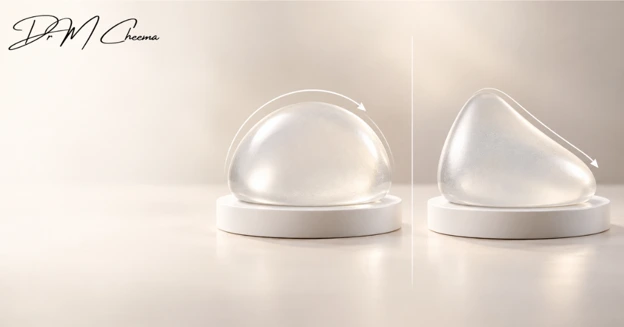
Round breast implants have a circular shape when viewed from the front. They are designed to distribute their volume relatively evenly around the implant. Because of their shape, round implants can provide fullness across the upper part of the breast, particularly when an implant with an appropriate profile and size is selected.
This can create a fuller appearance in the upper breast area. Round implants are available in different profiles, allowing the surgeon to select an implant that provides an appropriate combination of width and projection.
What Are Teardrop Implants?

Teardrop implants are also known as anatomical implants. They are designed with a shape that has more volume toward the lower portion and less fullness toward the upper portion. The intention is to create a contour that follows a more gradually sloping breast shape.
Anatomical implants can be useful in certain situations where a patient or surgeon wants a particular distribution of volume. They may also be considered when there is limited natural breast tissue or when specific breast proportions need to be addressed.
Round vs Teardrop Implants: What Is the Main Difference?
The main difference is how the implant distributes volume.
Round implants have a more uniform circular shape, while teardrop implants have a fuller lower portion and a more tapered upper contour. This can influence the appearance of the upper breast and the transition from the chest to the breast. However, the difference is not always dramatic.
The appearance of an implant depends on several factors, including how much natural breast tissue covers it and where it is placed. A round implant with a suitable size and profile can create a very natural looking result in some patients. Similarly, a teardrop implant does not automatically guarantee a natural looking breast.
This is why implant selection needs to be personalised rather than based solely on the implant shape.
How Do Round Implants Change the Final Look?

Round implants can provide noticeable fullness throughout the breast. Depending on the implant profile and placement, they may create more fullness in the upper portion of the breast. This can contribute to a more pronounced breast contour.
Some patients specifically prefer this type of appearance, while others want a softer transition between the chest and breast. The final appearance can also change depending on whether the implant is positioned beneath the breast tissue, beneath the muscle, or using another appropriate placement selected by the surgeon.
The amount of natural breast tissue also matters. A patient with more existing tissue may have an implant that appears softer and less defined, while someone with less tissue coverage may have more visible implant characteristics.
How Do Teardrop Implants Change the Final Look?
Teardrop implants are designed to create a gradual increase in fullness toward the lower breast. This shape can produce a gently sloping upper breast and may resemble the natural distribution of breast tissue in some patients.
The result can be particularly relevant for patients who want less upper breast fullness and a more gradual contour. However, the appearance depends on the individual. Breast shape before surgery, chest wall anatomy, skin elasticity, implant size, implant projection, and implant placement can all affect the result.
Do Round Implants Look Less Natural?
Not necessarily. This is one of the most common misconceptions about implant shape. A round implant can look very natural when the implant is appropriately selected for the patient’s anatomy.
Natural looking results depend on much more than the shape of the implant. The implant must be appropriate for the patient’s breast width, available tissue, skin characteristics, desired volume, and overall proportions.
The implant profile also influences how much the breast projects forward. A well-planned round implant can therefore produce a soft and balanced appearance rather than an excessively full upper breast.
Discuss Your Breast Augmentation Goals
Thinking about breast augmentation but unsure whether round or teardrop implants are right for you? Arrange a consultation with Dr. Cheema to discuss your desired breast shape, volume, upper breast fullness, and available implant options.
Do Teardrop Implants Always Look More Natural?
No. Although teardrop implants are designed to mimic the gradual contour of a breast, choosing an anatomical implant does not automatically create a natural looking result. The overall appearance depends on the relationship between the implant and the patient’s existing tissues.
An implant that is too large, too wide, or otherwise poorly matched to the patient’s anatomy may not produce the desired result regardless of its shape. This is why a consultation is important before choosing between round and teardrop implants.
What Is an Implant Profile?
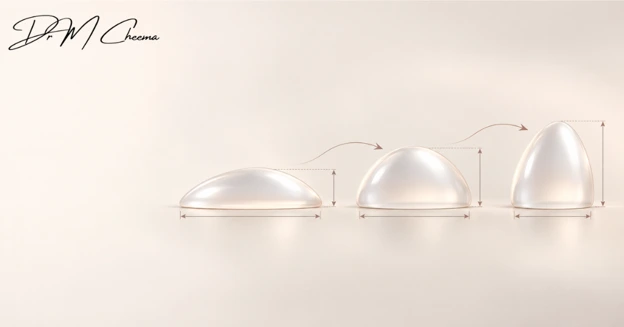
Implant profile refers to how far an implant projects forward in relation to its base width. Two implants can have the same volume but different widths and projections. A higher profile implant may project further forward, while a lower profile implant may distribute its volume over a wider area.
Profile can therefore influence the appearance of the breast from both the front and side. When choosing an implant, your surgeon considers measurements of the breast and chest to determine which dimensions are appropriate.
How Does Implant Size Affect Shape?
Size and shape work together. A round implant that is relatively small may produce a subtle increase in volume, while a larger implant can create a more pronounced change. Similarly, a teardrop implant can produce different results depending on its dimensions and projection.
Choosing the largest implant possible is not necessarily the best approach. An implant that is too large for the patient’s tissue and chest dimensions can create problems with stretching, visibility, discomfort, or an appearance that does not match the patient’s expectations.
The goal should be to select an implant that is appropriate for the patient’s anatomy and desired outcome.
Round vs Teardrop Implants for a Natural Looking Result
Patients often use the term natural looking to describe a breast that has a gradual contour and is proportionate to the rest of the body. For some patients, a teardrop implant may be appropriate for this type of result. For others, a round implant can produce an equally natural appearance.
The important point is that natural looking does not refer to one specific implant shape. A surgeon must consider the patient’s starting anatomy, the amount of existing breast tissue, skin quality, breast width, chest wall, implant dimensions, and desired volume.
This is why two patients requesting similar results may receive different implant recommendations.
Which Implant Shape Is Better for Small Breasts?
There is no universal answer. Patients with smaller breasts may have less natural tissue available to cover an implant, making implant dimensions and placement particularly important.
Some patients may be suitable for round implants, while others may benefit from anatomical implants depending on their anatomy and desired result. Your surgeon can assess the amount of tissue available and explain what implant options may be suitable.
What Should You Consider Before Choosing an Implant?
Choosing between round and teardrop implants should involve more than looking at photographs.
Important factors include:
- Your existing breast volume
- Breast width
- Chest wall anatomy
- Skin elasticity
- Amount of tissue covering the implant
- Desired breast volume
- Desired upper breast fullness
- Implant profile
- Implant placement
- Lifestyle and activity
- Whether a breast lift may also be needed
- Your expectations for the final appearance
Your surgeon can use these factors to recommend implant dimensions and shape that are appropriate for your anatomy.
What Can You Expect During an Implant Consultation with Dr. Cheema?
During a breast augmentation consultation, you can discuss the changes you would like to make to your breast shape and volume. Dr. Cheema can assess your breast and chest anatomy and discuss implant size, shape, profile, placement, and other relevant factors.
You can also explain whether you prefer more upper breast fullness or a gradual breast contour. It is useful to bring questions to your consultation rather than feeling that you need to know exactly which implant you want before seeing your surgeon.
The purpose of the consultation is to help you understand your options and make an informed decision.
Round vs Teardrop Implants: A Quick Comparison
Round Implants
Round implants have a circular shape and can provide fullness across the breast. Depending on their profile and placement, they may create more upper breast fullness.
Teardrop Implants
Teardrop implants have an anatomical shape with greater volume toward the lower portion. They are designed to create a gradual upper breast contour.
The Final Result
Neither shape guarantees a particular appearance.
The result depends on implant dimensions, placement, natural breast tissue, skin characteristics, surgical technique, and individual anatomy.
Breast Augmentation with Dr. Cheema
Choosing breast implants is a personal decision, and the right choice depends on much more than whether an implant is round or teardrop. Dr. Cheema takes an individualised approach to breast surgery, considering each patient’s anatomy, existing breast tissue, proportions, expectations, and desired outcome when discussing treatment options.
If you are considering breast augmentation in Birmingham, speaking with Dr. Cheema can help you understand how implant shape, size, profile, and placement may influence your final breast appearance and which options may be appropriate for you.
Explore Your Implant Options
Every patient’s anatomy is different. Dr. Cheema can assess your breast measurements and tissue characteristics before discussing implant size, shape, profile, and placement. Contact the practice to learn more about your breast augmentation options.
Frequently Asked Questions
What is the difference between round and teardrop breast implants?
Not necessarily. Both implant shapes can produce natural looking results when appropriately selected for the patient’s anatomy. Implant size, profile, placement, and existing breast tissue also influence the final appearance.
Do round implants look more natural than teardrop implants?
At six weeks, scars may still be pink, red, darker than the surrounding skin, firm, or slightly raised. Some swelling can also remain. Six weeks is still relatively early in the healing process, so the appearance at this stage does not represent the final result.
Do teardrop implants look more natural?
Teardrop implants are designed to create a gradual breast contour, but choosing an anatomical implant does not automatically create a natural looking result. The final appearance depends on several individual and surgical factors.
Which implant gives more upper breast fullness?
Round implants can provide more upper breast fullness depending on their profile, size, placement, and the patient’s natural tissue. However, implant shape is not the only factor that determines upper breast fullness.
Can round implants look natural?
Yes. A properly selected round implant can produce a soft and balanced appearance. The implant needs to be appropriate for the patient’s breast dimensions, tissue coverage, and desired outcome.