

For many women, the physical changes pregnancy brings to the breasts are among the most emotionally significant and least discussed. Before childbirth, the breasts enlarge considerably as the body prepares for breastfeeding. During and after breastfeeding, they often reduce in volume rapidly, leaving the skin stretched and the breast tissue deflated. The result, familiar to so many mothers, is a breast that sits lower than before, looks flatter, and no longer reflects the energy and effort a woman invests in caring for her body and her family.
These changes are entirely natural. They are also entirely treatable. Breast reshaping after pregnancy is one of the most rewarding areas of aesthetic plastic surgery, because the patients who pursue it have clear, realistic goals rooted in regaining something they had before rather than changing something they never liked. With the right surgical approach, results can be genuinely transformative.
At his Birmingham practice, Dr. Cheema works with women who have completed their families and are ready to restore the breast shape and volume that pregnancy and breastfeeding altered. This guide explains what changes pregnancy causes, which procedures address them most effectively, and what you need to know before pursuing surgery.
What Pregnancy and Breastfeeding Do to the Breast?
To understand why surgical reshaping is so often the only effective solution, it helps to understand what happens to the breast during and after pregnancy at a tissue level.
During pregnancy, rising oestrogen and progesterone levels cause the breast glandular tissue to expand significantly. The breast may increase by one to three cup sizes, stretching the overlying skin to accommodate the additional volume. After birth, if breastfeeding follows, the breast remains full of milk producing tissue and continues to be stretched. Then, when breastfeeding ends and milk production ceases, the glandular tissue involutes rapidly. Volume is lost quickly, often within weeks, leaving behind a skin envelope that was stretched to accommodate a much larger breast and is now too large for what remains inside it.
The effect of this cycle on different women varies considerably. Some women experience only modest changes. Others, particularly those who breastfed for extended periods, had multiple pregnancies, or who had larger breasts to begin with, experience profound changes in breast shape, position, and volume. The degree of change is also influenced by genetics, age at the time of pregnancy, and the rate at which volume was lost after feeding ended.
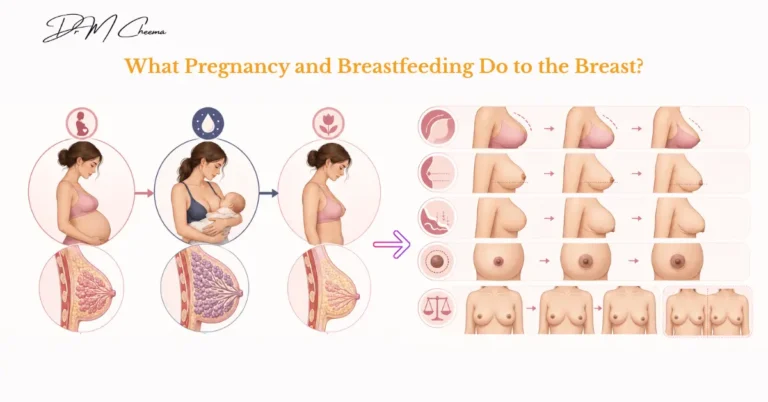
Several specific changes are commonly reported:
- Significant loss of upper breast fullness, leaving a flattened appearance above the nipple
- The nipple descending to or below the inframammary fold beneath the breast
- The breast appearing deflated, hollow, or drooping rather than projected
- Loose, excess skin that the reduced volume no longer fills
- Changes in areola size or shape following breastfeeding
- Asymmetry between the two breasts, particularly if one side was fed from more than the other
No exercise programme, cream, or non-surgical device can address these changes meaningfully. They are structural, involving the skin envelope and the volume of glandular tissue, and they require surgical correction to be genuinely improved.
Three Surgical Options for Post-Pregnancy Breast Reshaping
The appropriate procedure, or combination of procedures, depends on the specific changes present in each patient. There is no single solution that suits every woman, which is why a personal assessment is always the starting point rather than a blanket recommendation.
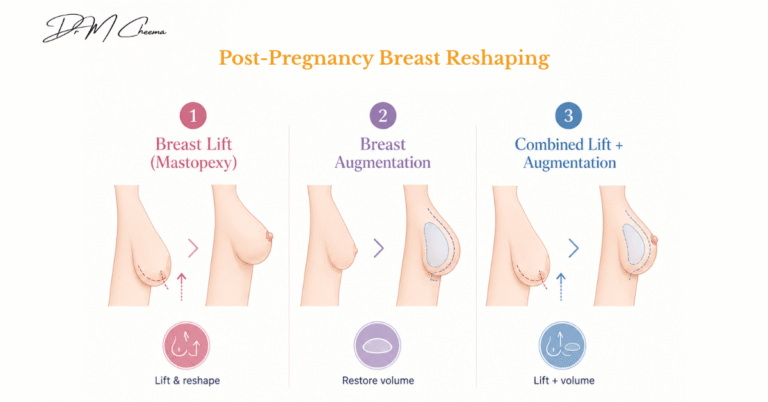
Breast Lift (Mastopexy)
Removes excess skin, reshapes the remaining breast tissue, and repositions the nipple to a higher, more youthful location. Addresses drooping and poor shape without significantly changing size. Ideal when volume is acceptable, but position has changed.
Breast Augmentation
Places an implant behind the breast tissue or chest muscle to restore volume and fullness. Best suited to women with reasonable skin tone and nipple position who have primarily lost volume rather than developed significant drooping.
Combined Mastopexy Augmentation
Addresses both volume loss and drooping in a single operation. The most indicated procedure for post-pregnancy reshaping, where the breast is simultaneously repositioned and restored in fullness. Technically demanding and highly effective for the right patient.
Why Most Post-Pregnancy Patients Need a Combined Approach
The pattern of change that pregnancy produces in the breast, simultaneous volume loss and skin stretching, means that a combined mastopexy augmentation is the most commonly appropriate procedure for women seeking post-pregnancy breast reshaping. Volume alone, delivered by an implant, cannot correct a nipple that has descended below the fold. A lift alone can reposition the nipple and remove excess skin but cannot replace the volume that was lost through breastfeeding involution.
When the two procedures are performed together by an experienced surgeon, the result addresses both problems simultaneously: the breast is repositioned to sit higher and project forward, and the volume that breastfeeding removed is restored by the implant beneath. For many patients, this combination produces results that are not simply an improvement on how they looked after pregnancy but a genuine restoration of how they felt their breasts looked before children.
Choosing the Right Implant After Pregnancy
For women undergoing augmentation or combined mastopexy augmentation after pregnancy, implant selection is an important part of the planning process. Several decisions need to be made, and each one influences the result.
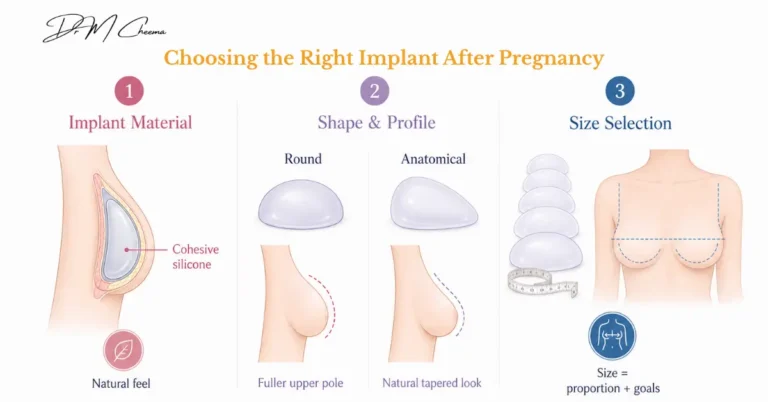
Implant Material
Modern breast implants in the UK are filled with cohesive silicone gel. Cohesive silicone implants hold their shape, feel natural to the touch, and do not migrate if the outer shell is ever compromised. Saline implants are rarely used in the UK for primary augmentation as silicone implants consistently produce more natural results, particularly in women who have little residual breast tissue after breastfeeding.
Implant Shape and Profile
Round implants provide fullness across the entire breast, with particular emphasis on the upper pole. They are a versatile choice and tend to produce a fuller, more rounded result. Anatomical or teardrop implants are shaped to be fuller in the lower pole and tapered toward the top, mimicking the natural breast shape more closely. For post-pregnancy patients who have lost significant upper pole volume, the choice between these two shapes is part of a detailed discussion at consultation.
Implant Size
Size selection is guided by the patient’s existing breast measurements, chest width, skin elasticity, and the goals she has articulated at consultation. Using implant sizers and three-dimensional imaging where available helps communicate what different sizes will look like on the specific patient’s frame. Mr. Cheema always discusses size in the context of what is proportionate and sustainable for the individual patient’s body, rather than simply choosing the largest size the patient requests.
When to Have Surgery: Getting the Timing Right
Timing is one of the most important factors in post-pregnancy breast surgery, and one of the most common sources of frustration for women who are eager to address the changes they see. The reasons for waiting are clinically important and, in the patient’s, best interest.
Consideration | Recommendation | Reason |
After breastfeeding ends | Wait at least 6 months | Breast volume continues to change as milk production fully ceases. Tissue needs time to stabilise before surgery can be accurately planned. |
Weight stability | Achieve and maintain target weight | Significant weight fluctuation after surgery affects the result. Stable weight produces the most predictable and lasting outcome. |
Future pregnancies | Complete your family first | A subsequent pregnancy will alter the surgical result significantly, potentially requiring revision surgery. |
General health | Optimise nutrition and fitness | Post-pregnancy nutritional deficits and fatigue should be resolved before elective surgery for the safest recovery. |
The right time to pursue surgery is when your body has fully settled after pregnancy and feeding, your weight is stable, and you are confident your family is complete. These conditions allow Mr. Cheema to plan surgery with precision and ensure that the results remain as stable as possible long-term.
Wondering Which Procedure Is Right for You?
Mr. Cheema assesses each patient individually to determine the exact combination of lift, implants, or both that will produce the best result for your specific anatomy and goals. Book your consultation at the House of Health today.
What to Expect: Your Journey from Consultation to Recovery
Initial Consultation
Mr. Cheema reviews your medical history, discusses the specific changes you have experienced since pregnancy, and examines your breast tissue, skin tone, and nipple position. Together you agree on a surgical plan that reflects your anatomy and goals. There is no obligation to proceed at this stage.
Pre-operative Preparation
Before surgery, you attend a pre-operative assessment appointment where blood tests and any required investigations are completed. You receive detailed written instructions about what to do and avoid in the days before your procedure, including guidance on medications, eating, and arranging support at home during early recovery.
Surgery Day
Breast reshaping procedures are performed under general anaesthesia. An augmentation typically takes one to two hours. A combined mastopexy augmentation takes two to three hours. Most patients are comfortable to go home the same day or the following morning after a period of monitored recovery in the clinic.
Early Recovery
For the first week, discomfort is managed with prescribed pain relief, and most patients find it is well controlled. A supportive surgical bra is worn continuously during this period. Lifting, reaching above the head, and caring for young children unassisted should be avoided for the first two weeks. Practical support at home during this time is essential to plan for in advance.
Return to Normal Life
Most patients return to desk-based or light work within two to three weeks. Exercise involving the upper body or chest is restricted for six to eight weeks. Final results are appreciated at three to six months as swelling settles and the breast tissue softens into its new position.
Follow-up and Aftercare
Scheduled follow-up appointments monitor your healing and the quality of your results throughout the recovery period. Scar management advice, including silicone gel and sun protection, is provided to support the best possible fading of any incision lines over the following 12 to 24 months.
Understanding the Scars
Every surgical procedure produces scars, and it is important to have an honest conversation about what this means in the context of post-pregnancy breast reshaping before proceeding with surgery.
For augmentation alone, the incision is small and is typically placed in the inframammary fold beneath the breast, making it invisible when standing and undetectable under clothing and swimwear. It fades to a fine, pale line in most patients within 12 to 18 months.
For a breast lift or combined procedure, more extensive incisions are required. The standard pattern involves a scar around the edge of the areola and a vertical scar running from the areola to the fold below. In cases of greater ptosis, a short horizontal scar along the fold is also included. These scars are permanent, but they mature and fade considerably over 12 to 24 months with appropriate care, and they are fully concealed beneath all standard underwear and swimwear.
For most post-pregnancy patients, the exchange of manageable scars for a breast that sits in the right position and has the right volume is one they make without hesitation. Mr. Cheema will show you realistic examples of how scars look at different stages of healing at your consultation.
Ready to Restore the Breast Shape Pregnancy Changed?
Book a private consultation with Mr. Cheema at the House of Health in Birmingham. Every appointment is conducted with care, confidentiality, and a genuine commitment to your individual goals.
Your Next Step Starts Here
The changes you see when you look in the mirror do not have to be permanent. For the right patient, in the right hands, surgery offers something genuinely meaningful: a body that reflects how you feel, rather than a record of what you have been through. Mr. Cheema’s role is not to tell you what you should want, but to listen carefully to what matters to you and to help you achieve it as safely and effectively as possible. If you are ready to explore what is possible, book a private consultation at the House of Health in Birmingham and begin the conversation at your own pace
Frequently Asked Questions
How long should I wait after breastfeeding before having surgery?
Wait at least six months after breastfeeding ends. This allows the breast volume to stabilise fully before surgery is planned.
Do I need a lift, implant, or both?
Most post-pregnancy patients need both. Volume loss is usually accompanied by drooping, and a combined mastopexy augmentation addresses both in one procedure. An in-person assessment confirms what is right for your specific anatomy.
Will I have visible scars?
A lift or combined procedure leaves scars around the areola and below. They fade significantly over 12 to 24 months and are fully concealed by underwear and swimwear.
Can I have surgery if I am still losing weight after pregnancy?
No. Weight should be stable for at least three to six months before surgery. Significant weight change after the procedure affects the result and may require revision.
How long is the recovery?
Most patients return to light work within two to three weeks. Upper body exercise is restricted for six to eight weeks. Results settle at three to six months.