
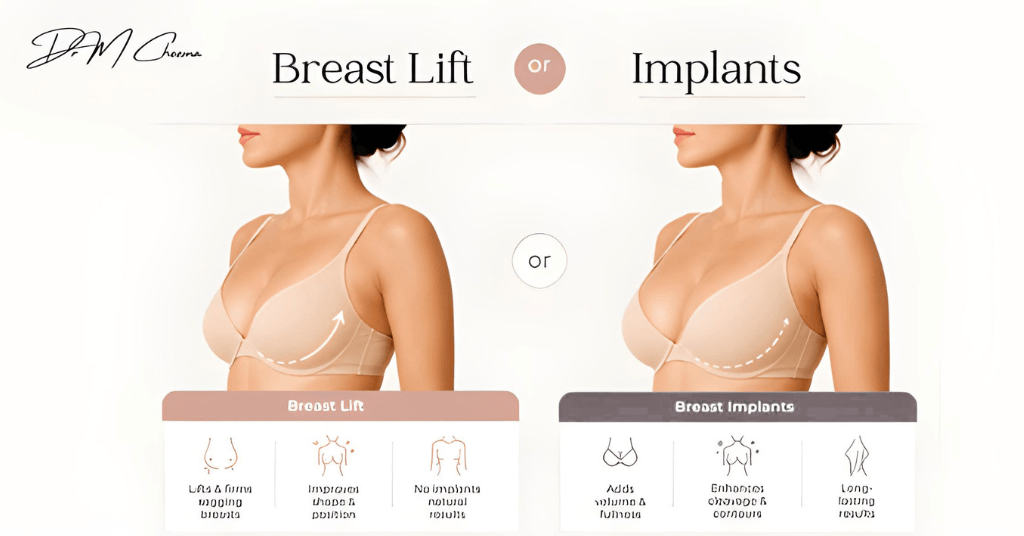
Breast lift and breast augmentation are two of the most performed procedures in aesthetic plastic surgery, and they are also two of the most frequently confused. Patients often arrive at consultation unsure whether they need one, the other, or both. This is entirely understandable, because the results of each procedure can appear superficially similar in before-and-after photographs, while the underlying problems they address are fundamentally different.
Getting this distinction right matters enormously. Placing implants into a breast that primarily needs lifting will not produce the result the patient wants and may in fact worsen the appearance of ptosis over time. Equally, performing a lift on a patient whose main concern is volume will leave them with a perkier but still small breast that does not reflect their goals. The right choice begins with an honest conversation about what is bothering you and a clinical assessment of what your breast tissue, skin envelope, and nipple position require.
At his Birmingham practice, Dr. Cheema takes a careful, individualised approach to breast surgery planning. This guide is designed to help you understand the key differences, the costs involved, and the factors that determine which procedure is most appropriate for your specific situation.
Understanding the Core Difference
The simplest way to understand the distinction is this: a breast lift addresses position and shape, while implants address volume and size. These are separate issues that may or may not coexist in the same patient.
A breast lift, known medically as a mastopexy, removes excess skin from the breast, reshapes the remaining breast tissue, and repositions the nipple and areola to a higher, more youthful position on the chest. It does not significantly change the size of the breast. After a lift, the breast sits higher and has a rounder, more projected contour, but the volume is broadly similar to what was there before.
Breast augmentation places an implant either behind the breast tissue or beneath the chest muscle to increase the size and fullness of the breast. It is highly effective at restoring or adding volume but does not address loose skin or a nipple that has dropped below the ideal position on the breast mound. If the skin envelope is too large for the volume being placed, the implant alone will not lift the breast to a satisfactory position.
Many women who seek breast surgery need attention to both volume and position. In these cases, a combined mastopexy augmentation (a lift and implants) performed together is the appropriate answer. This is also one of the more technically demanding procedures in breast surgery, requiring a surgeon with genuine experience in managing the two components simultaneously.
What Is Breast Ptosis and Why Does It Matter
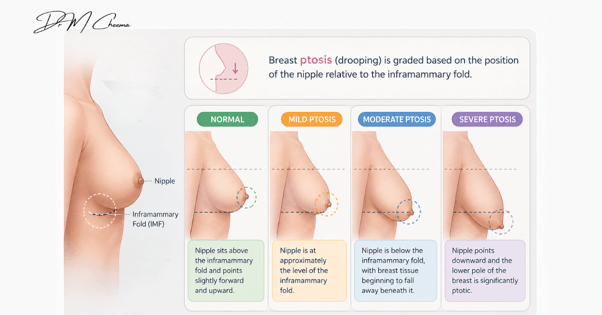
Ptosis is the medical term for drooping, and in breast surgery it is the central concept that determines whether a lift is needed. Breast ptosis is graded on a scale that describes how far the nipple has descended relative to the inframammary fold, the crease beneath the breast where it meets the chest wall.
In an ideal breast position, the nipple sits above the inframammary fold and points slightly forward and upward. As ptosis develops, the nipple descends toward and then below this fold. Mild ptosis describes a nipple at approximately the level of the fold. Moderate ptosis places the nipple below the fold, with the breast tissue beginning to fall away beneath it. Severe ptosis occurs when the nipple points downward and the lower pole of the breast is significantly ptotic.
The grade of ptosis determines whether a lift is needed, what type of lift incision pattern is most appropriate, and whether the correction can be achieved with a lift alone, with implants alone in mild cases, or with the two procedures combined. This assessment can only be made in person at consultation, which is why photographs and self-assessment alone are never sufficient to plan breast surgery.
Breast Lift vs Implants: A Side-by-Side Comparison
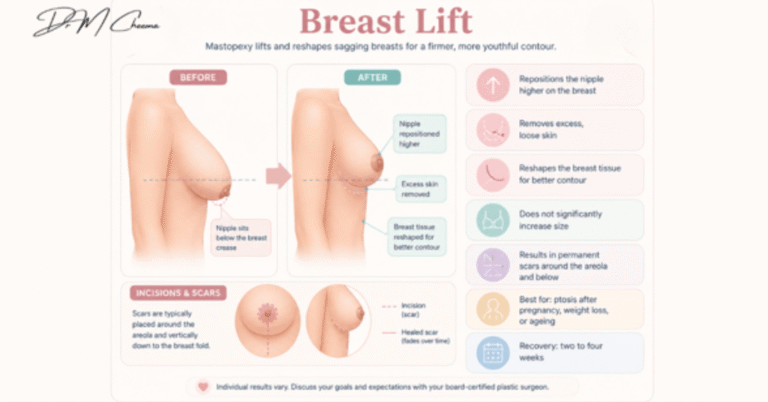
- Repositions the nipple higher on the breast
- Removes excess, loose skin
- Reshapes the breast tissue for better contour
- Does not significantly increase size
- Results in permanent scars around the areola and below
- Best for: ptosis after pregnancy, weight loss, or ageing
- Recovery: two to four weeks
Breast Implants
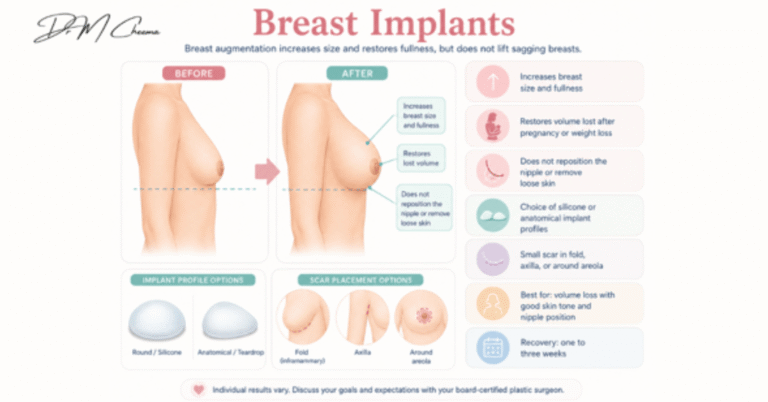
- Increases breast size and fullness
- Restores volume lost after pregnancy or weight loss
- Does not reposition the nipple or remove loose skin
- Choice of silicone round or anatomical implant profiles
- Small scar in fold, axilla, or around areola
- Best for: volume loss with good skin tone and nipple position
- Recovery: one to three weeks
Who Is a Good Candidate for Each Procedure
A Breast Lift Is Most Appropriate When
The primary concern is the position of the nipple and the shape of the breast rather than its size. Women who are broadly happy with their breast volume but find that their breasts have lost their youthful position following pregnancy, breastfeeding, significant weight loss, or simply the passage of time are typically ideal candidates for a lift. A lift is also the right starting point when the nipple has descended significantly below the inframammary fold, because no amount of volume will correct this mechanical problem.
Breast Implants Are Most Appropriate When
The primary concern is size and fullness, and the skin tone and nipple position remain acceptable. Women who have always had naturally smaller breasts, or who have experienced mild volume loss following pregnancy and breastfeeding while retaining reasonable skin tone, are often well served by augmentation alone. If the nipple sits at or above the fold and the skin envelope is not significantly redundant, implants can produce a full, lifted-looking result without the need for a formal mastopexy.
A Combined Mastopexy Augmentation Is Most Appropriate When
Both volume and position need to be addressed simultaneously. This is an extremely common presentation among women in their thirties and forties who have completed their families. After pregnancy and breastfeeding, the breasts have often lost significant volume while the skin has stretched, leaving a deflated and ptotic appearance that neither a lift nor implants alone would adequately correct. Combining the two procedures produces a breast that is both fuller and repositioned, with results that can be truly transformative for the right patient.
Not Sure Whether You Need a Lift, Implants, or Both?
A personal assessment with Mr. Cheema is the only reliable way to determine the right procedure for your anatomy and goals. Book your consultation at the House of Health in Birmingham today.How to Choose: A Practical Guide
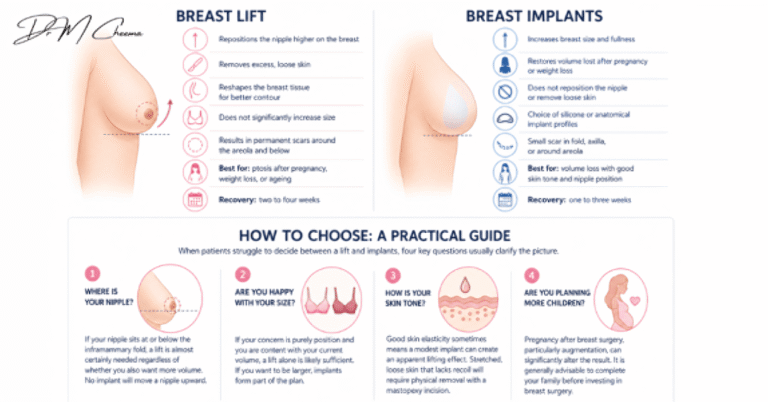
When patients struggle to decide between a lift and implants, four key questions usually clarify the picture.
Where Is Your Nipple?
If your nipple sits at or below the inframammary fold, a lift is almost certainly needed regardless of whether you also want more volume. No implant will move a nipple upward.
Are You Happy with Your Size?
If your concern is purely position and you are content with your current volume, a lift alone is likely sufficient. If you want to be larger, implants form part of the plan.
How Is Your Skin Tone?
Good skin elasticity sometimes means a modest implant can create an apparent lifting effect. Stretched, loose skin that lacks recoil will require physical removal with a mastopexy incision.
Are You Planning More Children?
Pregnancy after breast surgery, particularly augmentation, can significantly alter the result. It is generally advisable to complete your family before investing in breast surgery.
Scars: An Honest Conversation
One of the most significant differences between a breast lift and implants a from a patient’s perspective is the extent of scarring. Breast augmentation scars are typically small and well hidden, placed either in the inframammary fold beneath the breast, around the lower edge of the areola, or in the axilla. In most cases they become barely visible with time and are concealed entirely by underwear and swimwear.
A breast lift requires more extensive incisions because skin must be removed and the nipple repositioned. The most common pattern involves a scar around the areola, a vertical scar running from the areola to the fold beneath the breast, and in cases of greater ptosis, a horizontal scar along the inframammary fold. This pattern is sometimes described as an anchor or inverted T scar. The presence of these scars is the most frequent hesitation patients express when a lift is recommended.
It is important to view scars in context. For patients with significant ptosis, the trade of visible scars for a breast that sits in a proper, youthful position is overwhelmingly worthwhile. Scars also fade considerably over 12 to 24 months, and with appropriate scar management including silicone products and sun protection, the result in most patients is far less conspicuous than they feared at the outset. Mr. Cheema discusses realistic scar expectations thoroughly at consultation so that no patient is surprised by the healing process.
Recovery: What to Expect After Each Procedure
Both breast lift and augmentation are performed under general anaesthesia and require an overnight stay or same-day admission depending on the extent of surgery. Most patients return home the same day or the following morning and are comfortable managing at home with appropriate support during the first few days.
After augmentation, most patients find they can return to desk-based work within one to two weeks and resume light exercise within four to six weeks. After a breast lift, or a combined procedure, recovery is typically slightly longer, with most patients comfortable returning to work in two to three weeks and resuming full activity at six to eight weeks. A supportive surgical bra is worn for several weeks in both cases, and heavy lifting and strenuous upper body activity are restricted during the initial healing period.
Results from breast augmentation are visible almost immediately, though swelling takes several weeks to settle fully. The result of a lift takes three to six months to appreciate as the swelling resolves, and the breast tissue settles into its new position. Implant size and shape are assessed at follow-up appointments throughout this period.
Why Choosing the Right Surgeon Matters More Than Choosing the Right Procedure
Breast surgery, whether lift, augmentation, or a combination, is one of the most personally significant decisions a woman can make. The outcome affects not just appearance but self-confidence, clothing choices, comfort, and emotional wellbeing for years to come. The difference between an outstanding result and a disappointing one most often comes down not to the technology or implant brand, but to the judgement, skill, and integrity of the surgeon performing the procedure.
Dr. Cheema has been a Fellow of the Royal College of Surgeons in Plastic Surgery with over twenty years of experience in aesthetic and reconstructive breast surgery. His approach at the House of Health in Birmingham is built on thorough consultation, honest advice, and surgical precision. He will never recommend a procedure that is not appropriate for your anatomy, and he will always take the time to ensure you understand exactly what surgery can and cannot achieve before you make any decision
Ready to Find Out Which Procedure Is Right for You?
Book a private consultation with Mr. Cheema at the House of Health in Birmingham. Every appointment is thorough, confidential, and completely without pressure.Frequently Asked Questions
How do I know if I need lift or implant?
If your nipple has descended to or below the crease beneath your breast, you need a lift. If your main concern is size and your nipple position is acceptable, implants may be sufficient. Many patients need both. Only an in-person assessment can confirm which applies to you.
Can implants alone give a lifting effect?
Only in cases of mild ptosis with good skin tone. If there is any meaningful drooping or the nipple sits at or below the fold, implants alone will not correct the position and may worsen the appearance of sagging over time.
. Will I have visible scars after a breast lift?
Yes. A breast lift requires incisions around the areola and below it to remove skin and reposition the nipple. These scars fade significantly over 12 to 24 months and are not visible in clothing. Mr. Cheema will show you exactly where incisions are placed and what the scarring looks like at follow-up for comparable patients.
How long does recovery take place?
Most patients return to desk-based work within one to two weeks after augmentation alone, or two to three weeks after a lift or combined procedure. Strenuous exercise is restricted for six to eight weeks in all cases.
Should I wait until after having children before getting breast lift or implant?
Yes, if possible. Pregnancy and breastfeeding significantly alter breast volume and skin tone and can substantially change the appearance of surgical results. Completing your family before breast surgery gives you the most stable and long-lasting outcome.