
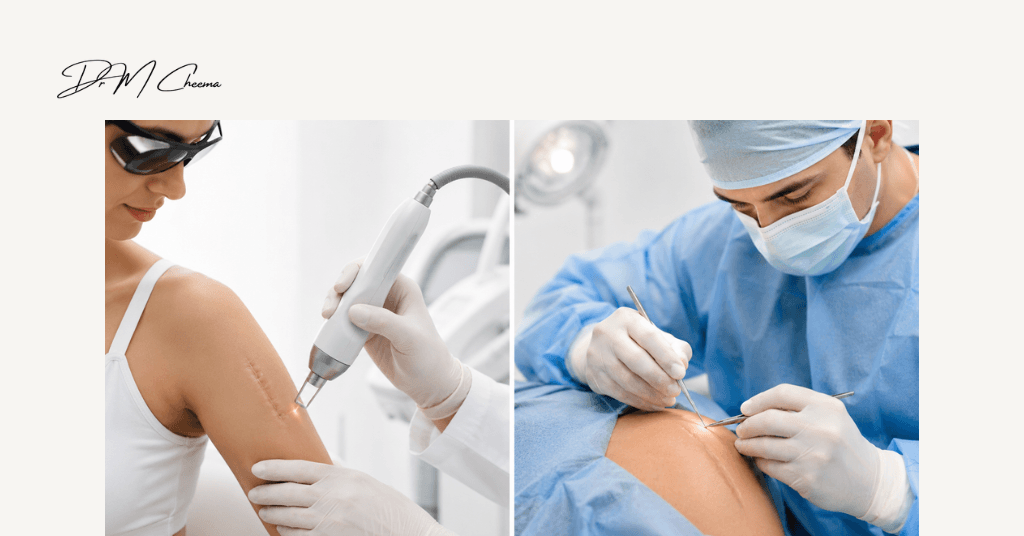
Scars are a natural part of the body’s healing process. Whether caused by acne, surgery, burns, trauma, or skin conditions, most people carry at least one scar they would prefer to improve. The good news is that modern cosmetic medicine offers more options than ever before. The challenge lies in choosing the right treatment for your specific scar type, skin tone, and personal goals.
Two of the most discussed approaches are laser treatment and surgical scar revision. Both can produce remarkable results, but they work very differently, suit different patients, and come with distinct recovery timelines and expectations. Understanding the differences is the first step toward making an informed decision.
At Mr. Cheema takes a personalised, evidence-based approach to scar management. This guide will walk you through everything you need to know before your consultation.
There is no single universal treatment for scars. The best outcome depends on the scar’s type, location, age, your skin tone, and your overall health. A professional assessment is always the starting point.
Understanding Different Types of Scars
Before comparing treatments, it helps to understand that not all scars are alike. The category your scar falls into will largely determine which treatment approach is most appropriate.
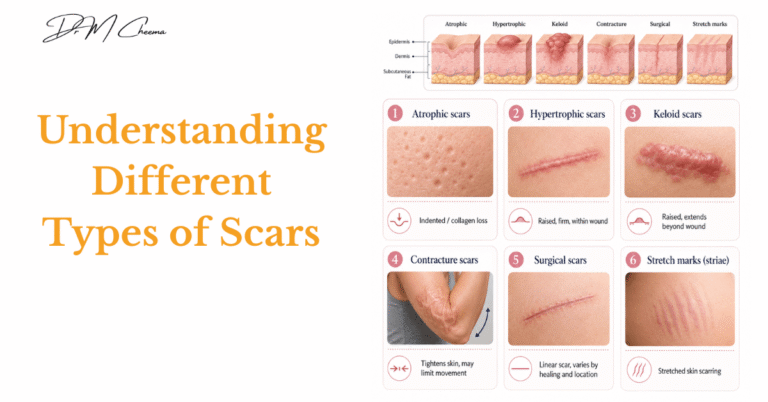
- Atrophic scars sit below the surrounding skin surface. Acne scars and chickenpox scars are typical examples. They form when the skin loses collagen during healing.
- Hypertrophic scars are raised, firm, and red, but remain within the boundaries of the original wound. They occur when the body produces too much collagen.
- Keloid scars also involve excess collagen but extend beyond the wound edges. They can continue growing over time and are more common in people with darker skin tones.
- Contracture scars result from burns or wounds over joints. The skin tightens, sometimes restricting movement. These often require surgical intervention.
- Surgical scars vary widely in appearance depending on surgical technique, wound closure, location on the body, and individual healing characteristics.
- Stretch marks (striae) are a form of scarring caused by rapid skin stretching. They require specific treatment protocols.
What Is Laser Scar Treatment?
Laser treatment for scars is a non-surgical procedure that uses focused light energy to target and remodel scar tissue. It does not remove the scar entirely but rather stimulates the body’s natural healing response to replace old scar tissue with smoother, healthier-looking skin.
How Laser Works on Scars
There are several types of lasers used in scar treatment, and each works through a different mechanism. Ablative lasers such as CO2 and Erbium:YAG remove the outer layers of skin, triggering new collagen production as the skin heals. Non-ablative lasers, such as pulsed dye lasers and Nd:YAG, penetrate below the surface without removing the top layer, targeting blood vessels, pigment, or deeper collagen structures.
Fractional laser technology has been a major advancement in this field. Fractional lasers create thousands of tiny micro-treatment zones in the skin while leaving surrounding tissue intact. This dramatically speeds up recovery compared to fully ablative treatments while still producing significant collagen remodelling.
What Laser Treatment Can Address
Laser treatment tends to be most effective for improving the colour, texture, and surface quality of scars. It works particularly well for red or pink post-surgical scars, acne scars with textural irregularities, sun-damaged or pigmented scars, and mild hypertrophic scarring. It can soften the appearance of stretch marks, though complete removal is not achievable through any current treatment.
Limitations of Laser Treatment
Laser treatment has real limitations. It cannot correct scars that are severely misaligned, deeply indented, or involving excess skin. Multiple sessions are typically required, often three to six treatments spaced four to eight weeks apart. Results are gradual and may take six to twelve months to fully manifest. Patients with darker skin tones must be treated with care, as certain laser wavelengths carry a higher risk of post-inflammatory hyperpigmentation or hypopigmentation.
Not Sure Which Treatment Fits Your Scar?
Book a consultation with Mr. Cheema for a detailed assessment of your scar type and a personalised treatment plan.
What Is Surgical Scar Revision?
Surgical scar revision involves physically altering or removing the existing scar tissue and reclosing the wound using advanced plastic surgery techniques. Rather than stimulating the skin to remodel itself gradually, surgery can immediately change the scar’s shape, orientation, length, or position.
Common Surgical Scar Revision Techniques
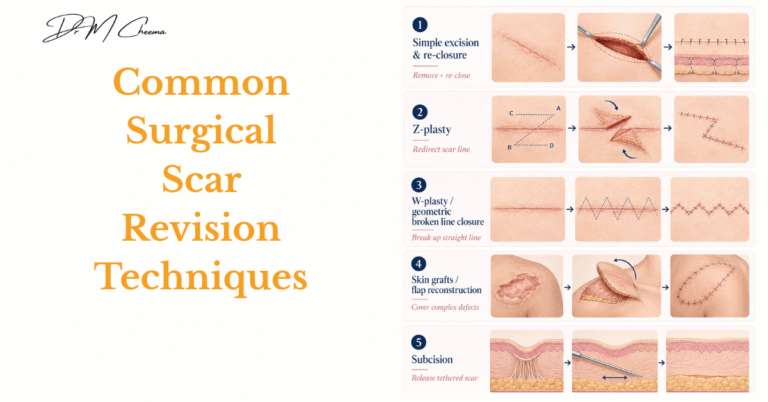
Simple excision and re-closure is the most straightforward approach. The old scar is removed and the wound is sutured in layers using fine plastic surgery techniques, often producing a neater, thinner scar than the original.
Z-plasty is a technique where the scar is cut in a Z-shaped pattern and the skin flaps repositioned. This changes the direction of the scar so it lies along natural skin tension lines, making it far less visible. It is also highly effective for releasing contracture scars.
W-plasty and geometric broken line closure (GBLC) break up a straight scar into irregular patterns that are much less noticeable to the eye than a single straight line, particularly on the face.
Skin grafts and flap reconstruction are used when there is insufficient local tissue or when large, complex areas need addressing. These techniques transplant skin from another part of the body or rearrange nearby tissue to cover the scarred area.
Subcision involves inserting a needle beneath the skin to break the fibrous bands tethering an atrophic scar to deeper tissue. This is a minimally invasive surgical technique often combined with filler or laser treatment.
What Surgery Can Address
Surgical revision is often the better choice when a scar is significantly raised, widened, or has poor orientation relative to natural skin creases. It is usually necessary for contracture scars restricting movement, for wide or split surgical scars, and for cases where laser treatment has plateaued without reaching the patient’s goals.
Limitations of Surgical Scar Revision
It is important to understand that surgery replaces one scar with another. The aim is to replace an unsightly or problematic scar with a finer, more strategically placed one. There is always a recovery period, typically two to four weeks depending on the procedure, and in some cases a combination of surgery followed by laser treatment produces the most refined result.
Laser vs Surgery: A Side by Side Comparison
Factor | Laser Treatment | Surgical Revision |
Invasiveness | Non-surgical, topical anaesthetic | Surgical, local or general anaesthesia |
Number of sessions | 3 to 6 sessions typically | Usually one procedure |
Recovery | 2 to 14 days depending on laser type | 2 to 4 weeks |
Results timeline | Gradual over 6 to 12 months | Visible immediately, mature over 12 months |
Scar types treated | Atrophic, pigmented, hypertrophic (mild) | Raised, widened, contracture, misaligned |
Skin tone considerations | Higher risk in darker skin with some lasers | Applicable to all skin tones |
Typical cost | Lower per session, multiple sessions needed | Higher upfront, fewer procedures overall |
Best combined with | Microneedling, fillers, PRP | Post-surgical laser to refine result |
Can Both Treatments Be Used Together?
Absolutely, and this combination approach is increasingly recognised as the gold standard for complex scar improvement. Many patients achieve the best outcome when surgery is used first to structurally correct the scar, and laser treatment is then used in subsequent months to further refine texture, colour, and surface quality.
For example, a patient with a wide, raised surgical scar on the abdomen might first undergo excision and re-closure with layered suturing. Once the new scar has settled over three to six months, a series of fractional CO2 laser treatments can then smooth out any residual surface irregularity and encourage further collagen remodelling. The final result of this combined approach is consistently superior to either treatment used in isolation.
Similarly, patients with acne scarring often benefit from subcision (a minor surgical procedure) combined with fractional laser and dermal fillers. Mr. Cheema takes a holistic view of scar management and will discuss every available modality during your consultation.
Factors That Determine the Best Treatment for You
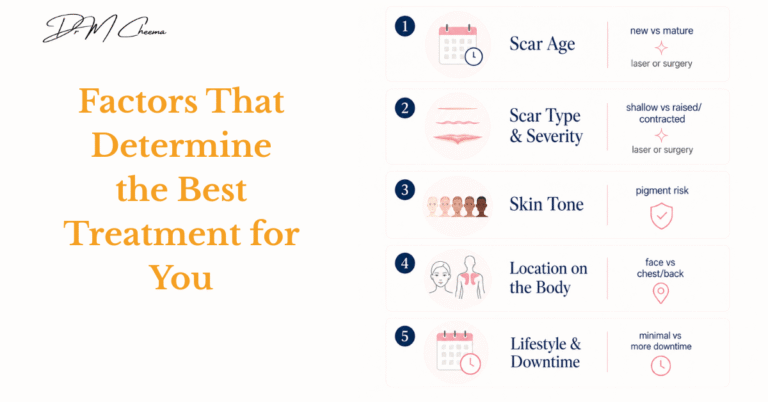
The question of which treatment is best cannot be answered without considering your individual circumstances. Several key variables influence the decision.
Scar Age
New scars, typically less than a year old, are still actively maturing and may respond very well to early laser intervention or silicone-based management. Older, fully matured scars may require surgery to achieve meaningful structural change, as the tissue has become stable and fibrotic.
Scar Type and Severity
As outlined above, shallow or discoloured scars are ideal candidates for laser treatment. Scars that are raised, tethered, contractured, or significantly widened usually call for a surgical approach.
Skin Tone and Type
Your Fitzpatrick skin type matters enormously when selecting a laser. Lighter skin tones tolerate a wider range of laser wavelengths. Darker skin tones are at higher risk of post-inflammatory hyperpigmentation with ablative lasers, though non-ablative options and careful protocols can still produce good results. Surgery is generally more skin-tone-neutral, though keloid risk must be carefully considered in predisposed patients.
Location on the Body
Facial scars typically respond well to laser due to the face’s excellent blood supply and healing capacity. Scars on the chest, shoulders, and upper back are notoriously prone to hypertrophic and keloid healing, and treatment plans in these areas require additional caution regardless of modality chosen.
Your Lifestyle and Downtime Tolerance
For patients who cannot accommodate more than a few days away from work or social life, non-ablative laser treatments with minimal downtime may be preferred even if progress is slower. Those willing to invest in a more significant recovery in exchange for faster, more dramatic results may opt for ablative laser or surgical revision.
What to Expect at Your Consultation with Mr. Cheema
During your initial consultation at Mr. Cheema will perform a thorough assessment of your scar including its type, age, dimensions, and relationship to surrounding structures. He will discuss your goals, medical history, and any previous treatments you have undergone.
You will receive honest, evidence-based advice about what is realistically achievable. Both laser and surgical options will be discussed where relevant, and a staged treatment plan will be proposed if a combined approach is recommended. There is no pressure to proceed immediately, and time is always taken to ensure every question is answered.
Mr. Cheema is a Consultant Plastic Surgeon with extensive training and experience in both laser-based and surgical scar management. His approach prioritises natural-looking, lasting outcomes with a thorough understanding of each patient’s unique anatomy and skin characteristics.
Begin Your Scar Improvement Journey Today
Whether laser treatment or surgical revision is right for you, the first step is an expert consultation with Mr. Cheema.
Frequently Asked Questions
How many laser sessions will I need for my scar?
The number of sessions varies depending on the scar type, size, depth, and how well your skin responds to treatment. Most patients require between three and six sessions, spaced four to eight weeks apart. Acne scars often need more sessions than post-surgical scars
Can laser treatment completely remove my scar?
No treatment, including laser, can completely erase a scar. Scars are the result of permanent changes in the skin’s structure. What laser treatment can achieve is a significant improvement in the scar’s colour, texture, height, and overall visibility.
Will surgical scar revision leave a new scar?
Yes, every surgical procedure creates some degree of scarring. The aim of surgical scar revision is to replace an unsatisfactory scar with a finer, better placed, or less noticeable one. An experienced plastic surgeon like Mr. Cheema uses advanced closure techniques, strategic incision placement along natural skin creases, and layered suturing to minimise the appearance of the new scar.
How long after surgery can I have laser treatment on my scar?
The timing depends on the type of surgery and the type of laser being used. For post-surgical scars, early intervention with a pulsed dye laser (PDL) can begin as soon as sutures are removed and the skin is fully closed, sometimes as early as four to six weeks after surgery. This can significantly reduce redness and prevent hypertrophic changes.
How do I know if I am a good candidate for scar revision?
Good candidates for scar revision are in good general health, are non-smokers or willing to stop smoking before and after the procedure, have realistic expectations about what can be achieved, and have scars that have sufficiently matured before treatment is considered.