
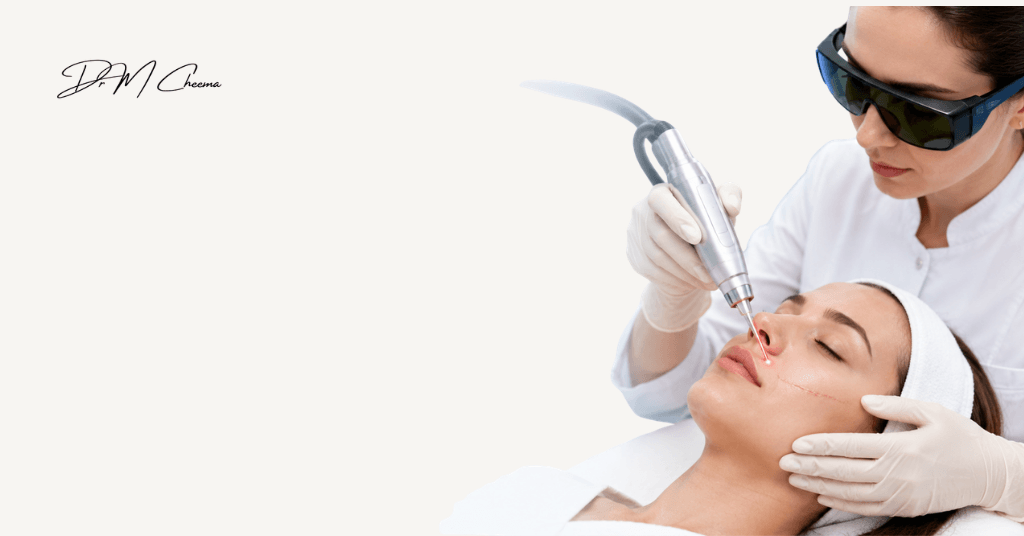
One of the most common questions asked at scar consultations is a simple and understandable one: can laser make my scar disappear completely? The honest answer is no, and any practitioner who tells you otherwise is overpromising. But that answer alone tells only part of the story, because what laser treatment can do for surgical scars is genuinely impressive when it is applied correctly, to the right type of scar, at the right time, by someone who understands the full range of scar management tools available.
Laser technology has advanced considerably over the past two decades. Today it is one of the most powerful non-surgical tools in scar treatment, capable of producing meaningful, lasting improvements in scar texture, colour, elevation, and overall visibility. For many patients, a course of well-planned laser sessions brings a surgical scar from something that draws attention every day to something that is barely noticeable in ordinary life.
This article explains how laser treatment works on scar tissue, which types of surgical scar respond best, what the realistic limits of the technology are, and how laser fits into a broader scar management plan at Dr. Cheema’s Birmingham practice.
Why Surgical Scars Form in the First Place
Every surgical incision, however carefully made and expertly closed, will produce a scar. This is not a failure of surgery; it is an inescapable biological fact. When the full thickness of the skin is breached, the body cannot recreate the original tissue. Instead, it produces collagen fibres rapidly to seal the wound. This repair collagen is structurally different from normal skin collagen. It is arranged in parallel bundles rather than the basket-weave pattern of healthy skin, and it lacks the follicles, pores, and pigment cells that give normal skin its characteristic appearance.
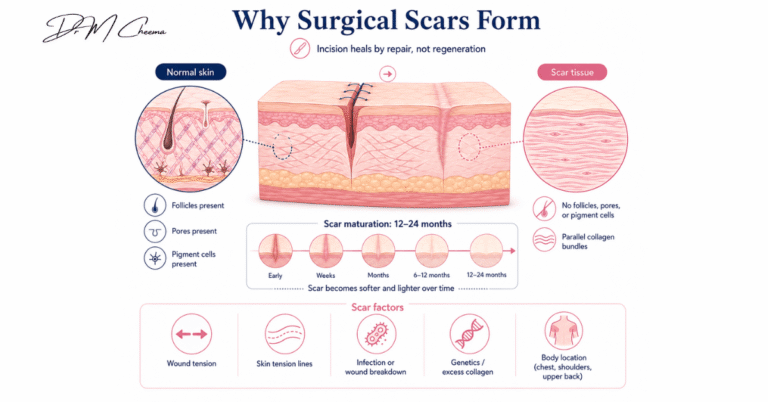
The result is scar tissue: a patch of skin that may be redder, paler, thicker, flatter, or more textured than the surrounding area. Over the first 12 to 24 months after surgery, scars mature naturally, typically fading in colour and softening in texture. But maturation has its limits. Scars that are wide, raised, deeply pigmented, or poorly positioned do not simply resolve on their own, and this is where active treatment becomes relevant.
Several factors influence how prominently a surgical scar develops. These include the tension across the wound during healing, whether the incision ran parallel to or against the skin’s natural tension lines, whether there was any infection or wound breakdown during recovery, the patient’s genetic tendency to produce excess collagen, and the location of the surgery on the body. Scars on the chest, shoulders, and upper back tend to be more troublesome than those on the face or inner arm, due to higher skin tension and movement in those areas.
What Laser Treatment Actually Does to a Scar
Laser treatment works by delivering controlled energy into scar tissue to trigger a biological response. Depending on the type of laser used and the settings selected, that energy can be absorbed by water molecules in the skin, by the haemoglobin in dilated blood vessels within the scar, or by abnormal pigment cells. Each of these targets a different aspect of the scar’s appearance.
When laser energy heats collagen within the scar, it causes the existing abnormal collagen to contract and break down. The body then produces new collagen in response to this controlled injury, and that new collagen is better organised, more similar to normal skin collagen, and results in a flatter, softer, more pliable scar. This process is called collagen remodelling, and it is the fundamental mechanism behind laser scar treatment.
In addition to remodelling collagen, lasers can reduce the redness of immature scars by targeting the blood vessels within them and can address areas of hyperpigmentation or hypopigmentation by modulating melanin production in the scar tissue. The result of a completed course of laser treatment is a scar that sits flatter, reads less red, better matches the surrounding skin tone, and has a surface texture that is closer to normal skin.
Main Types of Laser Used in Scar Treatment
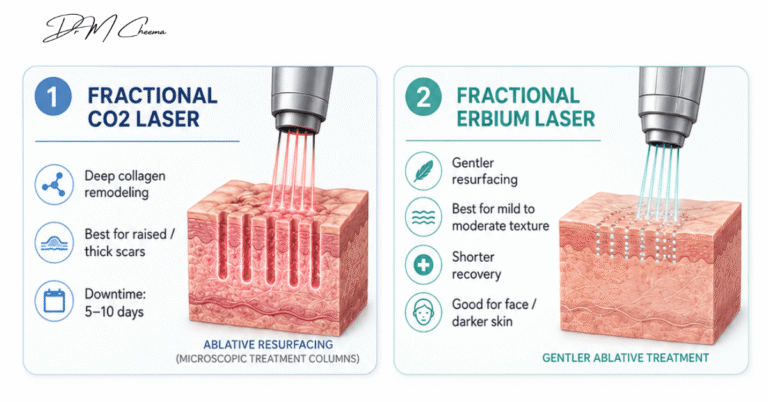
Fractional CO2 Laser
An ablative fractional laser that creates microscopic columns of treated tissue surrounded by untreated skin. Stimulates deep collagen remodelling and resurfaces the outer layer. Highly effective for raised, textured, or thick surgical scars. Requires a recovery period of five to ten days.
Fractional Erbium Laser
A gentler ablative option than CO2, with a shorter recovery period. Well suited to surface texture irregularities and mild to moderate scar thickness. Often preferred for scars on the face or in patients with darker skin tones due to a lower risk of post-treatment pigmentation change.
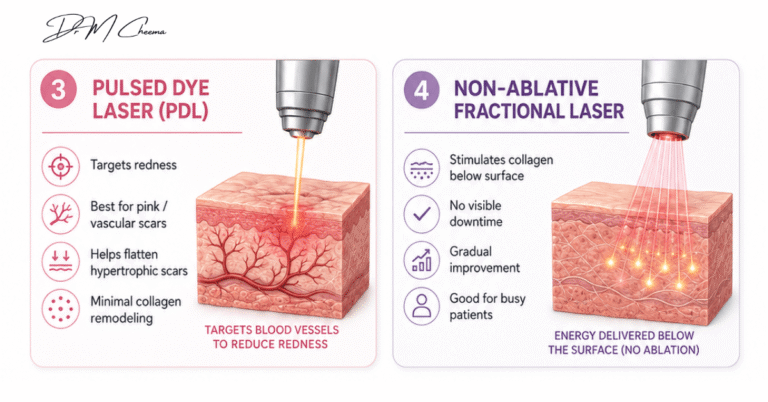
Pulsed Dye Laser (PDL)
Targets haemoglobin within the blood vessels of red or pink scars. Reduces vascularity, flattens hypertrophic scars, and dramatically improves the colour of immature or vascular scars. Does not significantly remodel collagen but is highly effective for the redness component of surgical scarring.
Non-Ablative Fractional Laser
Delivers energy beneath the skin surface without removing the outer layer, meaning no visible recovery period. Stimulates collagen production over a course of treatments. Results are more gradual than ablative options but the approach suits patients who cannot take time away from work or daily life for recovery.
In practice, the choice of laser is guided by the type of scar being treated, the patient’s skin tone, the location of the scar on the body, and the degree of improvement sought. Many patients benefit from a combination of laser types over the course of their treatment programme, with each session targeting a different aspect of the scar’s appearance.
Which Surgical Scars Respond Best to Laser Treatment
Not all surgical scars are equal candidates for laser therapy. Understanding which scars respond most favourably helps set realistic expectations and ensures patients are not subjected to treatment that is unlikely to help.
Scar Type | Laser Response | Notes |
Red or pink immature scars | Excellent | Pulsed dye laser reduces vascularity rapidly and effectively |
Hypertrophic (raised) scars | Very good | Fractional CO2 or PDL flattens and softens significantly |
Flat, pale, mature scars | Moderate | Texture can improve; pigment mismatch is harder to fully correct |
Atrophic (sunken) scars | Moderate | Collagen stimulation helps but volume loss may need filler support |
Keloid scars | Limited alone | Laser best used alongside steroid injections for keloid management |
Contracture scars | Supportive role | Surgical release is primary; laser helps surface appearance afterwards |
Scars that are relatively recent, still red, and not yet fully mature tend to respond most dramatically because the collagen within them is still active and more receptive to remodelling signals. Older, pale, flat scars are harder to improve because the tissue has already settled into a more stable, less responsive state. This is one of the reasons why early intervention with laser, typically from around three to six months after surgery, often produces the best outcomes.
Honest Truth About Complete Removal
It is worth addressing this question head-on, because it is the one most patients most want answered. Laser treatment cannot remove a surgical scar completely. The tissue that was disrupted by surgery cannot be restored to its original state by any available technology. The collagen architecture, the follicular structure, and the pigment distribution of a true scar are permanently different from those of the surrounding skin, and no laser system currently available can reverse that at a cellular level.
What laser can do is make a scar so much less visible that it ceases to be a daily concern for the patient. Clinical studies consistently show that patients who complete a course of fractional laser treatment for surgical or traumatic scars report reductions in scar visibility of between 40 and 70 percent across measures of colour, texture, height, and overall appearance. Many patients describe feeling that their scar has become something they are no longer conscious of, even if a close examination under good lighting would still reveal it.
This outcome, while not complete removal, represents a genuinely significant improvement in quality of life. It is also why honest consultation matters so much: patients who understand from the outset what laser can realistically achieve are far more satisfied with their results than those who were promised complete elimination and received something less.
How Laser Fits Into a Broader Scar Management Plan
Laser treatment is most powerful when it is used as part of a thoughtfully planned overall approach to scar management rather than as a standalone solution. At Mr. Cheema’s Birmingham practice, scar treatment programmes are tailored to the individual patient and typically draw on several complementary tools alongside laser.
Early Wound Care and Silicone Therapy
From four to six weeks after surgery, silicone gel or sheeting is applied to the healing wound. This is the single best-evidenced non-surgical intervention for scar prevention. It hydrates the scar, reduces collagen overproduction, and can significantly improve how the scar matures before any active treatment begins.
Pulsed Dye Laser for Early Redness
From around three months after surgery, if the scar is red and vascular, pulsed dye laser sessions can be introduced to reduce vascularity and begin flattening hypertrophic tissue. These sessions are well tolerated and can be started earlier in the scar’s maturation than ablative treatments.
Fractional Laser for Texture and Thickness
Once the scar has matured enough to tolerate ablative treatment, typically from six months onwards, fractional CO2 or erbium laser sessions address the surface texture, thickness, and remaining colour irregularity. Sessions are spaced six to eight weeks apart to allow healing between treatments.
Adjunctive Treatments Where Needed
For raised scars, intralesional steroid injections may be combined with laser to further flatten the tissue. For sunken areas, dermal fillers can be used between laser sessions to restore volume. Surgical revision remains an option if the scar’s position or width requires physical correction before laser can optimise the surface.
Review and Long-Term Maintenance
Scar remodelling continues for up to two years after the original injury. Patients are reviewed regularly throughout their treatment programme and the plan is adapted as the scar responds. Some patients benefit from occasional maintenance sessions after their primary course to sustain the improvement achieved.
Not Sure Which Laser Treatment Is Right for Your Scar?
Mr. Cheema offers detailed scar assessments at his Birmingham clinic, where he will examine your scar, explain which laser approach is most appropriate, and give you honest, realistic expectations about what treatment can achieve.
What to Expect from a Laser Treatment Session
Laser scar treatment is performed as an outpatient procedure, typically taking between 20 minutes and an hour depending on the size and complexity of the scar being treated. Before the session, topical anaesthetic cream is applied to the treatment area for 45 to 60 minutes. For ablative treatments on larger scars or sensitive areas, local anaesthetic injections may be used to ensure complete comfort during the procedure.
During treatment, the laser handpiece is passed across the scar in a controlled pattern. Most patients describe the sensation of ablative laser as a snapping or warming feeling, which is well tolerated under appropriate anaesthesia. Non-ablative treatments produce little to no discomfort.
After an ablative session, the treated area will appear red, swollen, and may weep slightly for the first few days. The skin will heal within five to ten days, revealing an improved surface beneath. Non-ablative sessions carry minimal downtime, with redness that typically resolves within 24 to 48 hours. Sun protection is essential for several weeks after any laser session to protect the remodelling skin and prevent pigmentation changes.
When Surgery Should Come Before Laser
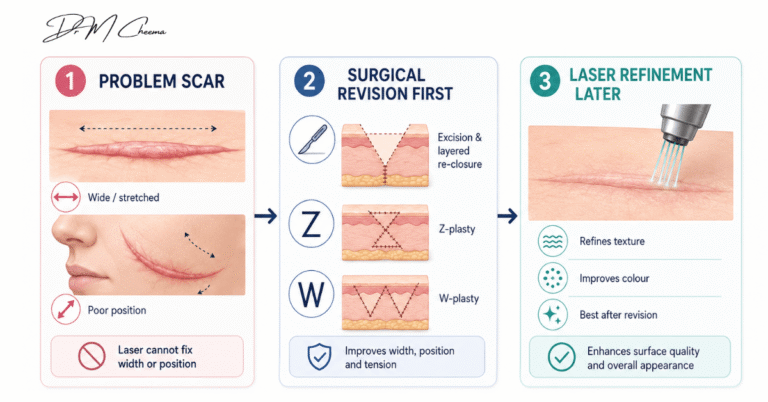
Laser treatment works on the surface and subsurface structure of a scar. It cannot correct the physical position, width, or orientation of a scar that is mechanically problematic. A wide, stretched scar that developed because of tension across the wound will not be significantly narrowed by laser. A scar that runs across facial tension lines and causes visible distortion will not be repositioned by any form of energy-based treatment.
In these situations, surgical scar revision is the appropriate primary intervention. Techniques such as excision and layered re-closure, Z-plasty, or W-plasty can physically narrow and reposition the scar before laser is then used to refine the surface result as the new scar matures. The two approaches work in sequence rather than in competition, and the combination frequently produces outcomes that neither could achieve alone.
Part of what Mr. Cheema brings to scar consultations is the ability to assess a scar across the full spectrum of available treatments and recommend the most logical sequence, rather than defaulting to a single modality that may not be the right starting point for the specific scar in front of him.
Ready to Find Out What Laser Treatment Could Do for Your Scar?
Contact Mr. Cheema’s team at the House of Health in Birmingham to arrange your private scar consultation. Every assessment is thorough, unhurried, and completely confidential.
Frequently Asked Questions
Can laser treatment completely remove a surgical scar?
No. Laser treatment cannot completely remove a surgical scar because the tissue disrupted by surgery cannot be restored to its original state. What laser treatment can do is produce a very significant improvement in a scar’s appearance, reducing its redness, flattening raised tissue, smoothing the surface texture, and improving its colour match with the surrounding skin.
How soon after surgery can I start laser treatment?
The timing depends on which type of laser is being used and how the wound has healed. For pulsed dye laser targeting redness, treatment can often begin from around three months after surgery once the wound is fully closed and stable. For ablative fractional laser treatments, most surgeons prefer to wait until six months or more after surgery to allow the scar to reach a more stable phase of maturation.
How long does recovery take after laser treatment?
Recovery varies by laser type. After ablative fractional laser sessions such as CO2 or erbium, the skin typically takes five to ten days to fully heal, during which time it will appear red, swollen, and may crust slightly. Most patients plan to take around a week away from social and professional commitments after these sessions. Non-ablative laser sessions carry minimal downtime, with redness that usually settles within 24 to 48 hours.
Is laser scar treatment suitable for all skin tone?
Laser treatment can be used safely across a wide range of skin tones, but the choice of laser type and settings must be adapted accordingly. Certain ablative lasers carry a higher risk of post-inflammatory hyperpigmentation in darker skin tones, where excess melanin may be affected by the laser energy. Non-ablative fractional lasers and pulsed dye laser systems are generally considered safer for patients with medium to darker skin.
Will I need surgery as well as laser treatment?
This depends on the nature of your scar. Laser is highly effective at improving surface texture, colour, and the quality of scar tissue. However, it cannot correct the physical width, position, or orientation of a scar. If your scar is wide, stretched, running against facial tension lines, or causing any distortion of surrounding tissue, surgical revision may be the most appropriate first step.