
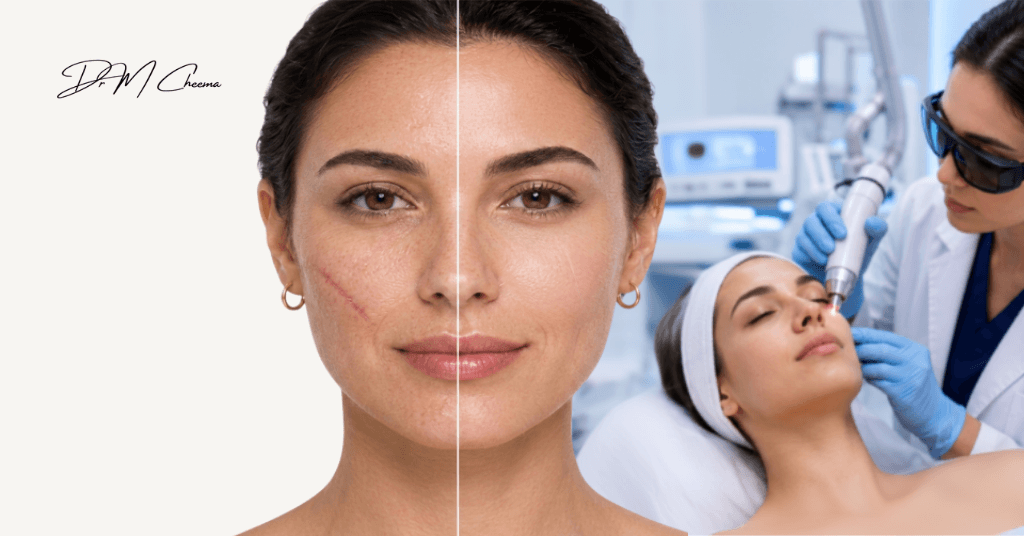
Facial scars are among the most emotionally significant marks the body can carry. Unlike scarring on the torso or limbs, a facial scar is almost impossible to conceal and difficult to ignore, both for the person who has it and for the world they move through each day. Whether formed by acne, surgery, trauma, burns, or an illness in childhood, a visible scar on the face can quietly erode confidence over years, influencing how people present themselves, how they socialise, and how they feel about their own appearance.
The good news is that modern plastic surgery and aesthetic medicine have advanced considerably. Today, facial scar treatment is not a single procedure but a carefully considered combination of approaches, tailored to the type of scar, the depth of the tissue disruption, the patient’s skin type, and the specific location on the face. At his Birmingham clinic, Dr. Cheema works with patients who are ready to address their scars with the expertise and precision that the face demands.
This guide explains what facial scars are, why they form, and what the most effective treatments available today can realistically achieve.
Understanding How Facial Scars Form
Every scar is the result of the body’s natural healing response. When skin is damaged beyond the superficial outer layer, the body cannot simply regenerate normal skin tissue. Instead, it produces collagen fibres rapidly to close the wound. This replacement tissue, the scar, differs in texture, colour, and structure from the surrounding skin. It lacks the normal pattern of fine lines, pores, and hair follicles, and often reflects light differently to healthy skin.
On the face, several features make scarring particularly noticeable. The skin of the face is rich in sebaceous glands, constantly exposed to movement, and highly vascular. Scars here are subject to daily stretching from expressions such as smiling, speaking, and chewing. They sit at the centre of where people direct their gaze in social interaction. And because we encounter our own faces many times each day, a facial scar is a constant presence in one’s self-awareness.
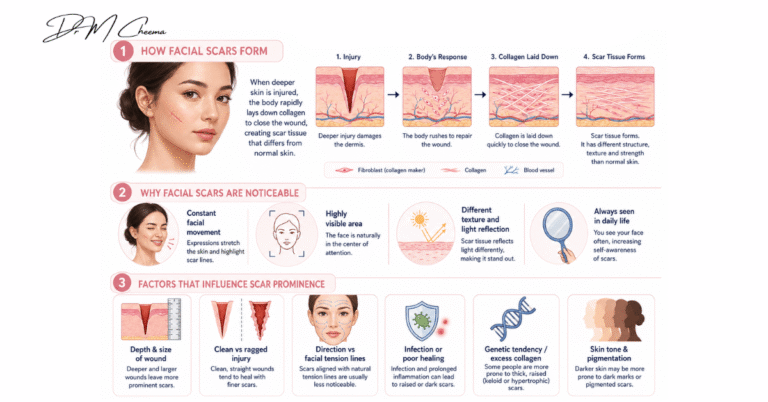
Several factors influence how prominently a scar develops:
- The depth and size of the original wound or injury
- Whether the wound was clean or ragged, surgically made or traumatic
- The direction of the wound relative to the natural tension lines of the face
- Infection, poor wound closure, or repeated trauma during healing
- Genetic tendency to produce excess collagen, which can lead to raised or hypertrophic scars
- Skin tone and pigmentation, which affect how noticeably a scar contrasts with surrounding skin
Different Types of Facial Scars
Effective treatment begins with an accurate understanding of what type of scar is present. Different scars respond to different interventions, and using the wrong approach can fail to improve the scar or occasionally worsen it. The main categories of facial scarring that Mr. Cheema treats at his Birmingham practice are described below.
Scar Type | Appearance | Common Cause |
Atrophic | Sunken, pitted, below the skin surface | Acne, chickenpox |
Hypertrophic | Raised, red, firm but within wound boundary | Surgery, trauma, burns |
Keloid | Raised, extends beyond original wound boundary | Surgery, piercings, trauma |
Contracture | Tight, pulling skin inward, may restrict movement | Burns, deep wounds |
Linear / Surgical | Fine line, visible due to colour or width | Previous surgery, lacerations |
A careful assessment at consultation determines which category your scar falls into and which combination of treatments is most likely to produce meaningful improvement.
Advanced Treatments for Facial Scar Removal
The word “removal” in scar treatment requires a degree of honesty. Scars cannot be erased entirely because the original tissue cannot be restored. What surgery and advanced aesthetic treatments can do is dramatically improve the appearance of a scar — making it flatter, softer, narrower, better matched to the surrounding skin, and far less visible in everyday life. For many patients, this improvement is transformative.
Mr. Cheema takes an evidence-based, individualised approach to facial scar treatment. The following are the principal interventions used, often in combination.
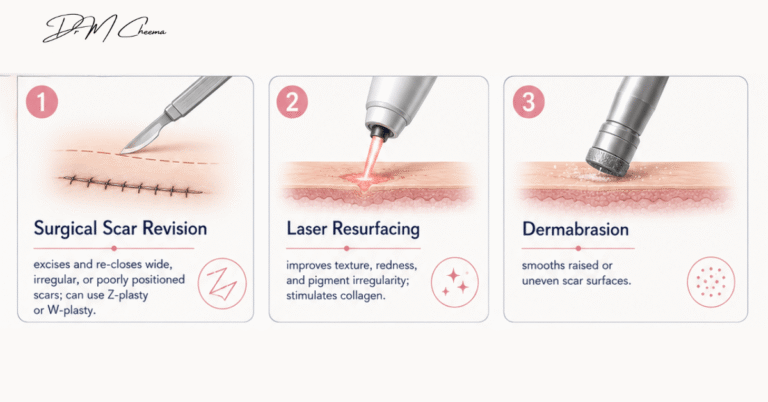
Surgical Scar Revision
Wide, irregular, or poorly positioned scars can be excised and re-closed with precision techniques that produce a finer, better-oriented result. Techniques such as Z-plasty or W-plasty reposition scars along natural facial tension lines where they become far less perceptible.
Laser Resurfacing
Fractional and ablative laser treatments stimulate collagen production, reduce redness, and improve the surface texture of scar tissue. Particularly effective for atrophic acne scarring, post-surgical scars, and scars with significant pigment irregularity.
Dermabrasion
A controlled mechanical technique that precisely removes the outer layers of the skin, smoothing raised or uneven scar surfaces and blending the scar into the surrounding skin. Best suited to specific scar types in appropriate skin tones.
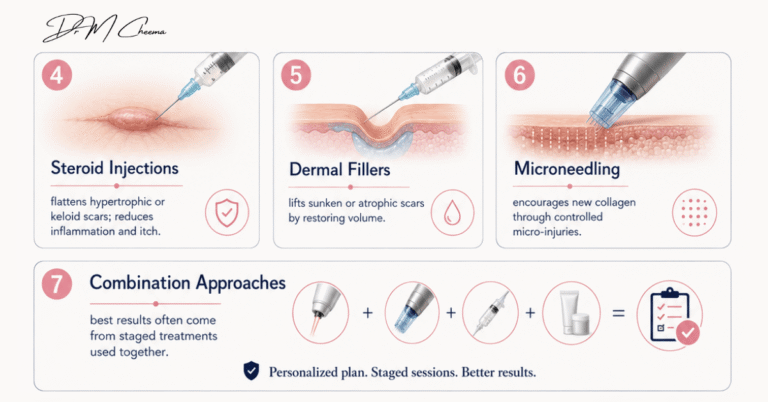
Steroid Injections
Intralesional corticosteroid injections are a first-line treatment for hypertrophic and keloid scars, reducing inflammation, flattening raised tissue, and relieving any itch or discomfort associated with these scar types.
Dermal Fillers
For atrophic or sunken scars, injectable fillers can temporarily restore volume beneath the skin surface, elevating the scar to the level of the surrounding skin and producing an immediate improvement in appearance.
Microneedling
Fine needles create controlled micro-injuries in the scar and surrounding tissue, triggering the body’s natural healing response and encouraging the production of new, more normally structured collagen over a course of treatments.
Combination Approaches
In practice, the most significant improvements often come from combining two or more of the above treatments. For example, a surgical revision to narrow and reposition a scar may be followed by laser resurfacing several months later to further refine the surface texture and reduce any residual redness. The treatment plan is always staged appropriately, with adequate healing time between interventions, and adjusted based on how the scar is responding at each review.
Not Sure What Type of Scar You Have?
Book a consultation with Mr. Cheema at his Birmingham clinic. He will assess your scar in detail and explain every treatment option available to you, with honest, realistic expectations at every stage.
Treating Acne Scarring on the Face
Acne scarring deserves particular attention because it is among the most common forms of facial scarring and one that affects people’s confidence from an early age. Severe acne, particularly cystic acne, inflames the skin deeply and damages the underlying collagen structure. When this damage heals, it often leaves behind atrophic scars: the characteristic pitted, icepick, boxcar, and rolling scar patterns that many adults carry long after their acne has resolved.
The treatment of acne scarring is rarely a single session affair. A realistic programme might involve an initial course of microneedling to stimulate baseline collagen repair, followed by fractional laser resurfacing to address surface texture, with occasional filler treatments for the deepest individual pits. Results accumulate over months rather than appearing overnight, and patience is essential. Patients who complete a full course of treatment consistently report substantial improvements in skin smoothness, texture, and the overall visual evenness of their complexion.
Post-Surgical and Traumatic Facial Scars
Scars that result from surgery or accidental injury to the face can vary enormously in how they heal. A well-placed surgical incision closed meticulously and in appropriate conditions may produce a barely visible fine line. A traumatic laceration that was poorly approximated, became infected, or crossed the natural stress lines of the face may result in a wider, more irregular scar that pulls on surrounding tissue or distorts natural facial features.
Surgical revision is often the most effective primary intervention for these scars. By excising the scar tissue and re-closing the wound using advanced techniques, Mr. Cheema can frequently produce a significantly improved result. Where the scar crosses tension lines, geometric techniques such as Z-plasty can break up the linear appearance and redirect the scar along a less conspicuous path. Post-surgical laser or steroid treatment can then be used to optimise the final result as healing progresses.
Keloid and Hypertrophic Scars: What Makes Them Different
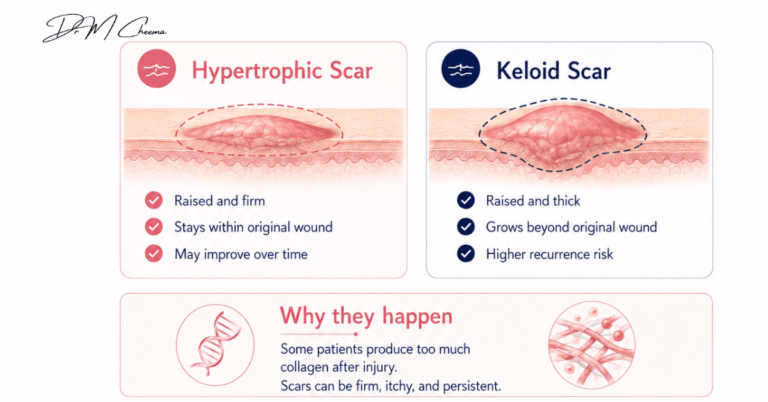
Some patients have a genetic tendency to produce excessive collagen in response to skin injury. This leads to raised, firm, sometimes itchy scar tissue that does not subside with time in the way most scars do. Hypertrophic scars remain within the boundary of the original wound; keloid scars extend beyond it, sometimes growing significantly larger than the original injury.
These scars require a different approach. Surgery alone can sometimes worsen keloid scarring by triggering further excessive collagen production. In most cases, treatment involves intralesional steroid injections to suppress collagen formation and flatten the scar, combined with pressure therapy and silicone-based products. Where surgery is indicated, it is combined with steroid injections immediately and postoperatively to reduce the risk of recurrence. These scars require careful long-term management rather than a single definitive procedure, and patients with keloid tendencies are counselled about recurrence risk from the outset.
What to Expect During and After Treatment
The treatment experience varies depending on the procedure involved. Non-surgical treatments such as steroid injections, microneedling, and filler are typically carried out in clinic with topical anaesthetic and require minimal downtime. Laser treatments may require a recovery period of several days to two weeks depending on the depth of treatment and the energy used. Surgical scar revision requires a formal surgical setting and a short recovery period before return to everyday activities, typically one to two weeks for most facial procedures.
Results evolve gradually. Scar tissue takes months to fully mature, and the final appearance of a treated scar is typically assessed at twelve months. Patients are reviewed regularly throughout this period so that the treatment plan can be adapted as the scar responds.
Why Expert Hands Matter in Facial Scar Treatment
The face is the most visible and most surgically demanding area of the body. Every millimetre of scar placement matters. The choice of technique, the timing of each intervention, the decision of when to operate and when to wait, these judgements require genuine expertise in plastic and reconstructive surgery, not simply an interest in aesthetics.
Dr. Cheema brings over twenty years of plastic, reconstructive, and aesthetic surgery to facial scar treatment. His training in the United Kingdom, Sweden, and Spain exposed him to some of the most technically demanding reconstructive challenges in surgery. This background informs his approach to even apparently straightforward scar cases, where the margin between a good result and an excellent one often comes down to experience, attention to detail, and a genuine commitment to the individual patient’s outcome.
Ready to Start Your Journey to Clearer, More Confident Skin?
Contact Mr. Cheema’s team in Birmingham to arrange your private scar assessment consultation. There is no obligation, and every conversation is treated with complete discretion.
Frequently Asked Questions
Can my facial scars be completely removed?
No scar can be completely removed because the body cannot regenerate tissue that is perfectly identical to the original skin. What modern scar treatment can achieve is a very significant reduction in visibility. Many patients, after a full course of treatment, find that their scar becomes barely noticeable in everyday life. The realistic goal is a scar that is flatter, narrower, better blended with surrounding skin, and far less defining than it was before treatment began.
How long does it take to see results from facial treatment?
Scar maturation is a slow process. Depending on the treatment, initial improvements may be visible within a few weeks, but the final result of any scar intervention takes 12 months or more to fully reveal itself. Non-surgical treatments such as microneedling or laser typically require a course of sessions before results become apparent. Surgical revision produces a new scar that then matures over the following year. Patience is genuinely important in scar management, and Mr. Cheema’s team will set realistic timelines at the outset of your treatment.
Is facial scar treatment painful?
Comfort levels vary depending on the treatment. Non-surgical treatments such as steroid injections and microneedling are performed under topical anaesthetic cream to minimise discomfort. Laser resurfacing is typically well tolerated with appropriate anaesthesia. Surgical revision is carried out under local or general anaesthesia, meaning there is no pain during the procedure itself.
Does skin tone affect which treatments are useful for me?
Yes, and this is an important consideration. Certain laser treatments carry a higher risk of post-inflammatory hyperpigmentation in darker skin tones, and some laser wavelengths are safer across a broader range of skin types than others. Mr. Cheema will assess your skin type carefully and select treatments that offer the best benefit-to-risk profile for your specific complexion.
I have a keloid scar on my face. What are my options?
Keloid scarring requires a specialist approach. First-line treatment usually involves a series of intralesional corticosteroid injections to flatten and soften the scar, often combined with silicone sheeting and pressure therapy between sessions. In some cases, surgical excision of the keloid may be appropriate, but this is always carried out in combination with steroid injection therapy immediately before and after surgery to reduce the risk of the keloid recurring.